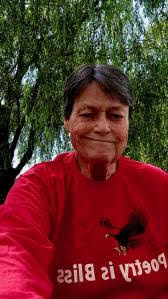
From Silence to Times Square: The Rise of Poet Robert E. BlissA Story by Adam Brown From Silence to Times Square: The Rise of Poet Robert E. Bliss  Robert E. Bliss does not write from imagination
alone. He writes from survival. In an era saturated with noise,
spectacle, and disposable content, the work of Robert E. Bliss arrives with a rare
and necessary gravity. His writing does not ask for attention. It earns it.
Shaped by war, loss, resilience, and a lifelong devotion to the quiet
disciplines of observation and craft, Bliss has built a body of work that feels
both deeply personal and unmistakably universal. As his words continue to reach
new readers, the world is beginning to recognize what has been quietly forming
for decades. A major literary voice. A poet forged by experience. And soon, a
face projected into the heart of Times Square as a symbol of endurance,
artistry, and truth. Robert E. Bliss does not write from
theory or trend. He writes from survival. Born in Los Angeles and raised
through a childhood marked by instability, abandonment, and foster care, Bliss
learned early how fragile life could be. Those formative years, shaped by
hunger, displacement, and the absence of protection, planted the seeds of a
perspective that would later define his writing. His work carries the clarity
of someone who has seen what happens when the world turns its back, and who
learned to keep going anyway. That clarity followed him into
adulthood and into the United States Marine Corps. In 1966, Bliss volunteered
for combat service in Vietnam. The decision would change his life forever.
During a brutal ambush, a mortar explosion nearly killed him, ultimately
resulting in the loss of his leg and a long, grueling recovery. Many people do
not return from such experiences in any meaningful sense. Bliss did. But he
returned altered, carrying not only physical wounds, but the psychological and
spiritual weight of war. What distinguishes Bliss from many war
writers is not simply that he survived, but how he chose to live afterward.
Rather than allowing bitterness or silence to define him, he turned inward, toward
language, reflection, and the slow reconstruction of meaning. Poetry became not
an escape, but a form of reckoning. Writing became a way to stay alive,
attentive, and honest. His poetry collections, including Bliss
Poetry: A Life Through Poetry and Poetry of Bliss, trace this inner
journey with remarkable restraint and precision. These are not ornamental
poems. They do not posture or perform. They speak plainly, sometimes quietly,
but always with intention. Themes of memory, faith, nature, guilt, recovery,
and grace recur throughout his work, woven together by what Bliss himself has
described as a wealth of hope. Not optimism. Hope. The kind that survives
devastation and learns how to stand again. Bliss’s poems often emerge from
moments others might overlook. A feather resting in grass. A lighthouse cutting
through fog. The companionship of a rescued animal. A mountain sunset in the
Catskills. These images are not decorative. They are anchors. They ground the
reader in the present moment while opening a doorway into something larger and
more enduring. His work reminds us that beauty does not disappear in hard
lives. It becomes harder to see, but no less real. This sensibility carries powerfully
into his memoir, Fragments of Bliss. The book is neither sentimental nor
self-indulgent. Instead, it unfolds as a series of lived moments that survived.
Childhood on the streets. Foster homes. Brotherhood. Combat. Amputation.
Addiction. Recovery. Art. Love. Loss. Stillness. Each fragment is rendered with
honesty and restraint, allowing readers to feel the weight of experience
without being instructed how to feel about it. Fragments of Bliss stands apart from traditional memoirs
because it resists spectacle. Bliss does not dramatize his suffering or polish
it into inspiration. He simply tells the truth and trusts the reader to meet
him there. In doing so, the book becomes something rare. A testament to
survival without ego. A record of pain without bitterness. A life story that
leaves room for silence. Beyond poetry and memoir, Bliss has
also built a compelling body of fiction. His novels East of Nostalgia
and Edge of Nostalgia draw deeply from his repeated journeys back to
Vietnam in later years, where memory, reconciliation, and cultural connection
converge. These works explore the long echo of war across decades and
continents, examining how the past continues to shape identity long after the
fighting ends. His novel Time Never Lands further extends this
exploration of memory and time, offering readers a narrative that reflects his
lifelong preoccupation with how moments endure. Across all genres, the throughline in
Bliss’s writing is attentiveness. He pays attention to what lasts. To what
hurts. To what heals slowly. To what remains when ambition fades, and only
meaning is left. Today, Robert E. Bliss lives a quiet
life in Highland, New York, surrounded by trees, books, and the steady presence
of nature. He reads constantly, writes daily, photographs the small wonders of
the world, and cares deeply about animals and the natural environment. This is
not a retreat from life. It is an engagement with it on its most essential
terms. His work reflects a man who has learned that stillness is not absence,
but depth. That is precisely why his emergence
into a larger public spotlight feels both unexpected and entirely deserved. In
a cultural moment hungry for authenticity, Bliss represents something
increasingly rare. A writer whose credibility comes not from branding, but from
lived truth. A poet whose authority is earned through experience, discipline,
and decades of quiet work. Soon, his face will appear in Times
Square, not as a novelty, but as a statement. A decorated Marine turned poet. A
survivor whose words now stand among the flashing lights of the world’s most
iconic crossroads. It is a moment rich with symbolism. The quiet voice stepping
into the loudest square. The poet who never chased attention is finally being
seen. This visibility is not the culmination
of his work. It is an invitation to readers who have not yet discovered him. An
invitation to slow down. To listen. To read words that do not rush past pain,
but walk through it with care. To encounter literature that believes beauty
still matters, even after everything else is gone. The books of Robert E. Bliss are not
simply must-reads because of who he is or what he survived. They are essential
because they remind us what writing can still do. It can bear witness. It can
heal without pretending. It can hold grief and hope in the same breath. And it
can prove that even lives shaped by fracture can produce something whole. In a world obsessed with the next
thing, Robert E. Bliss offers something lasting. And now, finally, the world is
ready to see him. © 2026 Adam Brown |
Stats
160 Views
Added on January 23, 2026 Last Updated on January 23, 2026 |

 Share This
 Email
Email Facebook
 Twitter
 Read Request
 My Library
 Subscribe
 Flag Writing