This is What Tyrants DoA Poem by Arezzo
(after Victor Hugo)
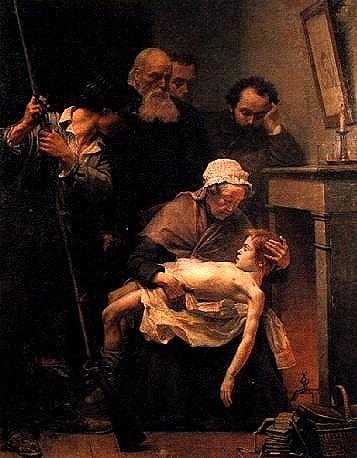
The child was dead. Two bullets in the head. The room was decent, humble,
honest, clean. An Easter palm was pinned to
some old print. A grandmother wept quietly
in one corner. In silence, we took off the
little boy’s clothes. His bloodless mouth gaped
open, and one eye stared wild, surprised,
unseeing, drowned in death. His arms appeared to ask us,
as they flopped, for help; one pocket held a
wooden top. You could have put a finger
in each hole. I don’t know if you’ve ever
seen a hedge with over-ripened
blackberries; that’s how the darkened clots
appeared. His broken skull reminded me of firewood,
split in two. The old grandmother watched
us as we worked, saying, “How pale he is!
Come near the lamp. Oh, God! His poor hair’s sticking to his head!” Once we were done, she held
him in her lap. The night was ugly. Shots were ringing still along the street. Others were being killed. “The boy has to be buried,”
someone said. A walnut cabinet gave up a
sheet, but grandma wasn’t ready. Not for that. She took him to the hearth
to warm him up, not noticing his legs,
already stiff. Alas! Our mortal fires can’t give back breath to those who’ve felt the icy
hand of Death. She bent her head and took
his little feet. “And isn’t this a thing to
break your heart?” she cried. “He wasn’t even eight years old! The teachers in that school
thought well of him. I tell you, Sir, if I should
need a letter, he wrote it for me. Are they terrorists? Sweet Jesus! Are they killing children now? I watched him play this
morning, at the door. This gentle little
creature. I am old, it would be nothing if I had
to die. So couldn’t Monsieur
Bonaparte shoot me, instead?” She stopped.
Her sobbing took control. Emotions mastered once
again, she said, “What am I going to do,
alone? Tell me. He’s all that I had left of
his poor mother. What did they kill him
for? I wish someone would walk in and explain it
all to me. Some shout for the Republic,
that I know, but not this little scrap of
life. Not him!”
We stood there glumly,
speechless, hats in hands, helpless before this grief
which couldn’t be eased.
I’m sorry, Ma’am. You don’t know politics. But Monsieur Bonaparte is
full of tricks. A commoner like you, he
feels that since he has the name, he ought to
be a prince. He likes fine horses,
servants, palaces, and Sandras, Julies, Saras,
Lucy’s, Alices. Of course, he’ll save the
Church, the Bank, protect the Family, and
folks of Rank. But first, he needs
Saint-Cloud’s unblemished lawns, where second-rates can come
and grovel, fawn, and flatter him. Such things just have to be. That’s why old women who can
barely see must sit up, weeping in the
dark and cold, to sew the winding-sheets of
seven-year-olds.
© 2015 ArezzoAuthor's Note
|
Stats
77 Views
Added on September 16, 2015 Last Updated on September 16, 2015 |


 Share This
 Email
Email Facebook
 Twitter
 Read Request
 My Library
 Subscribe
 Flag Writing