Train to Busan: Zombie Flick or Social Commentary?A Story by Julia Bellaflores Martin Social analysis on zombie film Train to Busan. Horror Films with an Agenda Train to Busan: Zombie Flick or Social Commentary? Julia Bellaflores Martin 2024 They call it “The Miracle on the Han River,” but for many who still foot the bill, the seemingly uplifting misnomer can be a depressing reminder that the exorbitant price tag still suffocates future generations with the burden of a miracle that, unfortunately, at times seems like a huge, yet probably unavoidable sacrifice. “South Korea up to well into the 1960s truly represented a backward, desolate economy based on subsistence agriculture,” and in international economic circles it is seen as a “miracle” that it only took some three decades for the country to transform into a “modern industrial power” (Kim). Yet, many Koreans today question if the obscenely rapid economic development, the so-called miracle, was worth it, or necessary, or the only option available. Today, South Koreans live in a super modern, internationally relevant nation that in addition boasts, among other tribulations, the lowest fertility rate in the world, one of the highest rates in suicide and in consumption of alcohol, as well as in poverty among the elderly, an elderly population that was catapulted into the future while still grasping onto their past, a past that still holds on to young generations with a tight grip of Confucian ideals in a world where Confucian ideals don't seem to fit. The previous commentary mimics some of the voices of these younger Korean generations, the ones that were not present and had no say in the matter back then, voices characterized by a fierce national pride combined with the freedom to also express their discontent, voices that strive to get a message across. They creatively use classic, centuries old, established art forms, like poetry, novels, and theater, along with more modern forms, like manhwa, webtoons, rap, video games, and other media to attract an audience and make themselves heard. Since film has always been such an effective vehicle to express social sentiment and reach the masses, and given the spotlight that now shines on the country, thanks in great measure to Kpop, Kdramas, and Hallyu, the Korean Wave that spreads like fire, it is no wonder Korean movies and serialized dramas have become one of their favorite mediums, especially, the horror film genre which lends itself as such a suitable weapon to force audiences into confronting topics and themes that can frighten one even more than corpses and haunted houses. With all this in mind and wanting to demonstrate how a horror film can deliver, not only vivid images of bloody gore, apocalyptic horror, fast paced action, and emotional drama, but also critical insight on society and human nature, this paper attempts to further analyze the 2016 South Korean zombie film Train to Busan to include commentary on the country's recent history and how it has affected modern Korean society. Was this film's main intention for it to be seen as a social commentary on South Korea? Probably not. Actually, the zombie film genre, although well established in the United States, is fairly recent in South Korea. The main goal for Train to Busan was most likely to succeed as a zombie film at a worldwide level, not to succeed as a local Social Science project. To this effect, in addition to following some of the trends of the genre, along with quite a bit of action and drama, many of the themes developed in Train to Busan are universal, which is one of the main reasons why the film was such a success not only in South Korea but also internationally. One does not have to be Korean or even know about Korean history, economics, politics, society, or the language to be able to relate to and enjoy the film. The producers took a risk in attempting to enter a genre that had a well established worldwide following, and the risk paid off. The movie broke records in Korea and quickly became a zombie fan favorite around the world. In order to achieve this, the film is in fact packed with gore, horror, action, and drama. The movie does not need to be analyzed any further than this in order to recognize its worth. The intent of this paper is not to prove that Train to Busan breaks away from the genre to become a reactionary film of social discord and discontent. The intent of this paper is to use Train to Busan as an example of how the horror film genre, in this case, a zombie film, lends itself as the perfect springboard for interpretations that can trigger conversations and discussions beyond the horror. Why a zombie film? As much as one could enjoy the excitement of two hours of zombie mayhem, the choice seems to have been made with additional reasons in mind. The horror film sub genre, which in itself has quickly earned the accolade of genre, has the “ability to embody a variety of cultural anxieties [like] ecological disaster, social and economic collapse, [or] political extremism” (Lauro). Although the COVID pandemic did not hit in full until 2019, three years after the movie's release, there had been enough world events with lingering psychological effects to trigger a myriad of cultural anxieties. First off, there will always be the post traumatic syndrome of 9112001 that had happened only eight years before; in addition there were infectious disease outbreaks previous to COVID, like SARS, Avian Flu, and Ebola; other political disasters like the refugee crisis in Syria and the terrorist attacks in France; events augmenting the fears of climate change disasters like the heat wave in India that killed thousands and the extreme hurricanes and forest fires in America; and even mysterious occurrences like the Malaysian airplane that disappeared... too many to keep on listing without the risk of succumbing to anxiety. Taking into account Lauro's assertion, the real world setting was perfect for director and scriptwriter Yeon Sang Ho to make the decision to dwell into zombie land. Furthermore, Train to Busan was actually not his first zombie venture. Yeon Sang Ho, now 45, who in his early thirties established a name for himself in adult animated films with the controversial King of Pigs on the topic of school violence, is without a doubt one of those young voices that is not afraid to express his discontent. Seoul Station, his animated zombie film that was also released in 2016, but created before Train to Busan, shares the premise of a zombie apocalypse in the same setting as the live action film, but can't really be seen as a prequel. If anything, they could be seen as two separate stories that share an event, a zombie outbreak in Korea. Seoul Station, a dark and depressing “animation that focuses on homeless people mistaken for zombies because of social prejudice” (Noh) was, without a doubt, created with social commentary as its primary goal. Yeon explained in an interview in 2016 that the idea of zombies came to mind when thinking about the homeless situation in Seoul and how a society that is always in a hurry has gotten so used to it that he wondered if people would even notice if the disenfranchised of the city suddenly became physically deformed, bloody monsters (Jang). Netflix, which bought the rights to stream Train to Busan, also carries the animated film now. Although not a success like the live action movie, its commentary on various social themes, like the disregard for the homeless and the inefficiency of governments to handle disasters, also brought to light much tension and criticism for the controversial portrayal of the main character, a “young ex-prostitute and runaway... [who] dies at the end of the narrative, with few people mourning her loss, only disappointed that they can no longer use her body for labour” (Austin). Seoul Station is, not only thought provoking but a trigger for arguments on women's roles and rights, as well as patriarchal and abusive perceptions that can be applied to societies around the world. The storyline for both movies, based on a highly-contagious infectious disease that turns the living into zombies, is not new and was actually already a hot topic among zombie fans. World War Z (2013), an apocalyptic action thriller and zombie creature film with the same premise and based on Max Brooks' 2006 pseudo-oral history novel World War Z: An Oral History of the Zombie War, as of the present time, is the highest grossing zombie film ever (Dirk). Yet, when talking about box office revenue, one has to bring to the table that since Train to Busan South Korea has become famous for its zombie Kdramas that stream worldwide and gain millions of fans and immense revenue for international streaming services like Netflix that in 2023 pledged to invest $2.5 billion dollars in the country that “has already become one of [its] biggest suppliers of TV shows and films” (Kim, Sohee). In the last three or four years, many hit zombie series have been released, like All of Us Are Dead with zombies in school; Happiness, zombies and police action; Zombie Detective, zombies with dark humor; Sweet Home, with zombie neighbors and a favorite already in its second season; and even zombies in the Joseon Dynasty with Kingdom, a historical fiction piece also in its second season (McCormick). All of these releases, including Peninsula, the 2020 sequel to Train to Busan, share characteristics of the horror and zombie genres with western films, albeit sometimes sprinkled with the occasional Kpop idol in the cast and an extra dose of heart wrenching emotional drama. In addition, like Train to Busan, they can all be interpreted to include some kind of social commentary on their country of origin, South Korea. As a matter of fact, if one traces the zombie all the way back to its origin in fiction, inspired by the folklore of Haiti and the Caribbean in times of colonialism, slavery, and all the cultural anxieties of over a century ago, one can see how the zombie evolved to become the ubiquitous and decomposing character now easily recognized. To a greater or lesser extent this evolution has come about as a reaction to social circumstances. Contemporary zombies “are born of infection, are the dead returned to life, and have a taste for human flesh,” but the original zombies “were neither sick nor cannibalistic; they were victims of an exotic religion, used as slaves, forced to submit to the will of a zombie master” (Kee). The evolution of the zombie could be analyzed hand in hand with the evolution of society in America, a society that traveled from religious and political control trying to walk forward leaving slavery, colonialism, and racism behind. Yet, it seems society actually walked into a world that still struggles with many of the same centenary issues caused by greed and human disregard; furthermore, one could speculate that now the world seems to be tumbling into a future apocalypse where the zombie perfectly represents the monstrosity of what society can become. In comparison, Gothic literature, the precursor to genres like horror, science fiction, and fantasy, which seem to dominate the film industry today, came about as a reaction to the new era of the Enlightenment during the Eighteenth Century. It grew astronomically during the next century, and has continued to grow and evolve to accommodate responses to social and cultural changes. According to Roger Luckhurst in his book, Zombies A Cultural History, “there are several anthologies of fiction that can be used to trace the history of the emergence of the pulp [fiction] zombie” as recognized today all the way back to the 1930's. Luckhurst explains that in movies, the 1932 White Zombie, considered to be the first of its kind, was actually a “typical piece of opportunism” that attempted to capitalize on the success of the horror film genre following Tod Browning's Dracula and James Whale's Frankenstein. The horror film genre helps our fears find resolution “in times of war, economic decline, grief on a community scale, terrorism and political and social upheaval” (Hatza). It is in this context of horror films as vehicles that facilitate the discussion of social topics as well as aid in social healing by prompting much needed conversations, that even a sensationalist movie like White Zombie can be interpreted to depict “the encounter between white and black, living and dead” and bring to the table controversial topics like racism, miscegenation, and religious censorship. It is also in this context of conversations and healing that a movie like Train to Busan can be interpreted in order to draw attention to controversial topics that need to be brought into the open so decisions made today are not regretted by generations in the future like seen in the film and in real life. It may be argued that contrary to the assumption that the plot of Train to Busan is a basic recount of events leading to a zombie apocalypse, in reality, the movie is the tragic story of a family split by the demands of a modern world that places the value of money and power over the value of humanity. Set at the beginning in present time in the northern city of Seoul, capital of South Korea, the movie quickly takes the audience on a trip to the countryside all the way to the city of Busan in the south. The main character in the story is Seok Woo, a young and overworked finance executive in the middle of the Seoul corporate rat race as well as in the middle of a divorce, the latter probably a consequence of the first. Seok Woo has temporary custody of his young daughter and wants it to stay that way, although he doesn't seem to have much time for her. The character is played by the famous Kdrama and movie heartthrob, Gong Yoo, a smart casting decision that helped guarantee the attendance of a big part of the audience, even if they were not fans of the zombie genre since the genre in South Korea did not have as big a following as in the West. His daughter, Soo An, played by child actor Kim Su An, ends up being as important a character as the father, if not more. It is his daughter's brave and humane behavior in the middle of tragic events that allows him to redeem himself after he had lost his way when following those who spearhead corporate greed and embrace disregard for basic tenets of morality and ethics. A simple analysis of their relationship could result in the daughter representing the section of young generations that revolt against the general establishment and its love for money, in pursuit of a more decent and compassionate life. Or it can be seen as an allusion to those moments in life when a parent actually learns a life lesson from a child. And it happens to be that in this moving father-daughter story there are also zombies crawling out of the woodwork. A man-made infectious disease that turns humans into zombies begins in Seoul and father and daughter, along with other metaphorically important supporting characters, are trapped inside a bullet train speeding south. Fast paced action mingles with claustrophobia and secondary stories of love, friendship, sacrifice, and greed, as one by one most of the characters succumb in their attempt to reach the safe city of Busan. The movie begins with a credits sequence that immediately establishes the main conflict. The short three-minute scene is packed with background information that allows the director to use the rest of the film to dwell in the lives and relationships of the characters instead of the why's and how's of the origin of the zombies. The very first image the audience sees in this movie is a close-up of a lifeless, life-size face of a male dummy, a doll's face that is, not just handsome, but pretty. The alluring shiny eyes and pouty lips juxtapose with the seriousness of the situation once the shot abruptly changes to a long shot of the dummy dressed up with a shiny safety vest and hard hat standing by a “quarantine zone slow down” sign. The pretty face reminds the audience of what is to come, the disfigured, ugly, and scary faces of the zombies. This is just the first of a series of contrasts director Yeon Sang Ho incorporates throughout the film. These result in an uneasy feeling that makes the audience pause to think about the reason why they are shown these images, which in turn adds to the tension and suspense. To add to the mood, in classic fashion, the clouds in the horizon look dark and menacing foreshadowing the near future. In what seems like a simple conversation between a rancher in an old pickup truck and the guard at the quarantine roadblock where vehicles are quickly sprayed with a disinfectant, we learn this is not the first time they have had quarantines and in the past ranchers have even had to destroy their animals. The rancher is upset and considers the roadblock a hassle, not a concern. In what reads like a cry wolf tale, the disgruntled man continues his journey after being inefficiently sprayed, maybe a nudge at governments for trying to patch up man-made disasters with band-aid solutions. Soon, distracted by his cellphone, maybe a nudge at those who become so distracted with communications and media that fail to see what is in front of them, he hits a deer with his truck. The deer is without a doubt dead. The guilty driver, upset, not for killing the animal, but concerned for the possible damage to his truck, curses and continues his journey. Disregard for life and a bigger concern for loss of money is exactly what caused the zombie outbreak, but at a higher financial level. This is one of the main themes in the film and the director gives it to the audience just three minutes into it, showcasing that human nature at its worst is not exclusive to those dealing with budgets of millions and billions. Up until this moment there has been no added music score in the movie, that is, until the camera pans across the landscape to the sound of the truck fading and stops on the image of the road kill. In a scene worthy of any western horror film, the deer starts to convulse in an attempt to stand up and soft music slowly increases to sounds of drums, dum-durum-dum to a close-up of the deer that turns its head towards the camera and, music in crescendo, the audience is forced to focus on its eyes. Milky white pupils, a trope of zombie films, and in real life, a symptom of disease or infection, are a motif throughout the movie. They are the unequivocal proof that whomever has white glazed eyes has lost the battle to a zombie. Later on, the audience is reminded of the deer staring into the camera with its white eyes when near the end of the movie the director offers a climactic parallel scene. Similar to World War Z, the zombies in Train to Busan are not the slow, stiff-legged, rotting-flesh, constantly limb-losing regular zombies. These are the crimson bloody kind that twitch and snap and run fast, with the ability to quickly pile up like ants on steroids. Film choreographer Jeon Young, known for his mastery of FlexN dance which originated in Brooklyn, reflects that he used one of the style elements of the dance genre, bone breaking, to create movements that ignore rhythm completely along with bizarre expressions that fit the tempo of the movie (Nam). Director Yeon, with his background in animation, effectively uses the piling up of zombies to increase the tension in the most critical parts, like the fast paced train chase close to the end. This portrayal of the zombies as a dance troupe with similar uncoordinated and painful to watch movements and their ability to climb over each other and effortlessly pile up diverts the attention from the individual to the entity, the conglomerate, both physically and figuratively. Once the human is infected and turned into one of them, there is very little singularity about that character. Similarly, once Seok Woo entered the treacherous and demanding corporate world, he lost his individualism, his morals, his ethics, his humanity, his individual life, to become a corporate zombie. On another aspect, as zombie gore goes, Train to Busan would probably be categorized as mild. Yes, they are bloody and gruesome and scary, but Yeon does not go out of his way to prove himself as the most grotesque of zombie movie directors. He does not dally in an “explicit depiction of zombies chomping human flesh [like] in Night of the Living Dead [where] young Karen Cooper [chewed] on her mother's severed arm” (Worland). There really isn't much time for chomping and chewing in Train to Busan. The movie reads like The Fast and the Furious of zombie movies once the action starts some twenty minutes into the plot. To counteract the speed, Yeon sporadically uses slow motion shots to emphasize the dramatism in some scenes, but speed is a fundamental part of the plot and social message in Train to Busan. The translated title of the movie makes reference to the actual KTX high speed bullet train that runs daily and frequently from Seoul, the capital of South Korea, to Busan, the second largest city in the country, some 260 miles away to the south. To get an idea of how busy and packed with people these trains can get, consider that “50.2% of South Korea’s total population of 51,829,000 people live in the [Greater Seoul Area which includes the city of Seoul], Incheon, and Gyeonggi Province” (Lee Ji-hye). Now consider how many people must have moved to the city during the past few decades, leaving behind the agricultural setting that used to be their home in order to support the country's rapid industrial growth. The actual train ride, at almost 200 miles per hour, interestingly takes around the same time as the movie to reach Busan. The train is not just a symbol that represents the speed at which the country's economy grew, the train is an actual example of the rapid growth of the nation. The passengers in the movie represent the people of Korea, children, students, executives, the homeless, white collar workers, young couples, married couples, pregnant women... They all board the fast speeding train blindly unaware that they were speeding into a future completely different from what they had envisioned. This can be seen as the way the country also blindly went along with the high speed economic growth plan only to arrive at a future with hardships they had not envisioned either. The movie is not called “Train to Seoul” for a reason. Koreans already took the symbolic speeding train to Seoul, into the future, decades ago. Yeon touches on the theme of societies needing to step away from the big cities and all that they represent in order to gain a vantage point that could guide humanity into a better, more balanced future. In the movie, they step away to Busan which becomes their beacon of hope. So, why Busan? As President Truman, Secretary of State Acheson, United Nations forces and the rest of the western world came to terms with the North Korean invasion, ninety thousand North Koreans overwhelmed South Korean troops as they stormed southward down the peninsula, quickly capturing the capital city of Seoul and devastating villages in their path (KWLP).
Like the movie, Busan, then known as Pusan, was the last bastion that was protected by the Korean military and their allies who created a heavily armed perimeter around the city, the Pusan Perimeter. Busan was the only city that remained unconquered by the North Korean military during the Korean War, so it became a shelter for people fleeing the war from all across the country and also became the nation's provisional capital for almost three years (Lee, Hae-rin). So why Busan? “If we hadn’t held the lines at Pusan, there would be no South Korea today” (KWLP). If they hold the lines at Busan in the movie, will there be a South Korea tomorrow? Will the military be able to save the country from the apocalyptic zombie attack? The audience is not privy to the answer, but there is, at least, hope. If Busan was once successful in protecting South Koreans from the North Koreans, maybe it could now save South Koreans from the zombies. Which brings us back to one more reason for choosing zombies over other horror movie monsters, like vampires, aliens, or werewolves. One of the most poignant tropes in zombie films is the part where a loved one is turned into a zombie and an enemy line is drawn between family members, neighbors, friends, and lovers. South Koreans and North Koreans were once one people. Like the zombies, they were once the brothers, sisters, husbands, wives, mothers, of those who had not been infected, but now a line is drawn and they are deadly enemies. One would have to be Korean to truly understand the pain of Korea's recent history and the weight of living in a country that is still at war with its other half. Only a ceasefire was agreed upon between North and South Korea decades ago; technically they are still at war. This technicality is obviously a big part of what has shaped the future of the country since the 1950's. South Korea needed to quickly recover and strategically become less vulnerable in the possibility of another attack from the North. This was probably the main trigger for coming up with a plan that could quickly take the country into a future of economic strength, a plan that was also the hope for a miracle, because in the 50's and 60's after the war, South Korea was in no position to survive another attack from the north or from any other cardinal point. Kim Namjoon of BTS, the famous, multimillionaire Kpop idol who was recently named goodwill ambassador for the Korean War Remains Recovery Agency, an agency “committed to recover and return Republic of Korea and allied forces’ fallen heroes to their homelands” (Idleburg), in defense of his country when international news outlets criticized South Korea's extreme work and study cultures, argued that “Korea is a country that has been invaded, razed, split in two. Only seventy years ago there was nothing” (Mane). This, in the words of a twenty-seven year old, who has also taken upon his shoulders the task of preserving and restoring overseas Korean cultural artifacts (Kwak) as well as promoting modern Korean art at a local and international level, this is the voice of the new generations characterized by a fierce national pride. In contrast, his words and those of BTS at times have also felt the urge and freedom to express discontent and through Kpop, a music genre that shies away from creating social waves, their songs have “addressed [politics and culture]... on multiple occasions, with a particular focus on youth-related issues such as mental health, bullying and suicide” (Herman). This brings us to another main theme in the movie. The sacrifice of the young generations as a result of the decisions made by those that came before them. Regardless of Kim Namjoon's fame and fortune, which are both immense, he has had to put his career and life on hold and join the Korean military along with the other six BTS members. The youngest, Jeon Jungkook, known for breaking all kinds of music records, was recently voted Male Artist of the Year by the People's Choice Awards in the United States, the first Asian artist to achieve this. BTS, who have officially addressed the United Nations on various occasions as well as visited the White House as official diplomatic ambassadors to South Korea, are a prime example of the burden that was placed on future generations in the name of the miracle. The young are not expected to be young for long in South Korea. In the movie, the train on its way to Busan makes a stop in the city of Daejeon and the passengers that up to now have survived the zombie attacks onboard disembark in hopes of finding safety in a city where the military has supposedly overturned the zombies. In a shift of camera shots showing the survivors inside the train looking out the window like members of an audience watching a movie and later the zombies trapped in the train looking out the window, this time their turn to be the audience, director Yoon reminds the actual audience watching the movie that we are all in the same boat, the same train. The survivors descend to the train station with high hopes, but soon realize that the many young men in uniform at the station are already zombies, the kind that travel in packs attacking as a bloody entity and violently converting everyone in their path. Director Yeon uses a combination of scene changes from slow motion to fast paced with deafening silence pierced by horrible screams to get across a heart pounding sequence that leaves even the bravest in the audience trembling. In the midst of the chaos, one bloodied soldier limps slowly toward Seok Woo and with tears in his eyes and a distraught semblance pleads for help just before another zombie soldier runs to finish him off. This scene is a painful allusion to the millions of men who throughout the years have been forced into the military starting at the young age of 18 with no one willing or able to help them. Talk about cultural and social anxieties! In addition, the military represented in Train to Busan also offers another contrast, this time between those in charge, calling the shots, but not really knowing how to deal with the situation, and the young soldiers who are put in the direct path of the zombies with tragic results. The military is romanticized in South Korea, like in many parts of the world, but few countries, if any, have a compulsory draft that has lasted for so many decades. The government is dealing at this moment with alarmingly declining birth rates and increasingly low marriage numbers, yet, in the past, any attempts at some kind of military recruitment reform have been mostly ignored. One would think that a country who has become such a powerful industrial magnate would be able to come up with a successful career path for voluntary military recruitment, but it seems it is more important to psychologically control the masses with claims of honor and sacrifice for the benefit of the nation, though in this day and age everyone knows that war is simply a money-making machine, an industry that is perpetuated by greed. Yet, it still merits mention that there is a very high probability that every man on that train to Busan, rich or poor, zombie or not, actor or staff, was a trained soldier. Except for the young men in the train car full of students on what seems like a baseball championship school trip, they would have been too young to have already completed their compulsory military service. Which makes us wonder what was the purpose of having the students in the film? In doing research, a possible allusion surfaces when one learns that ever since 2014, if you are Korean, a group of students going on a trip, like the ones in the movie, will probably bring to mind the Sewol Ferry incident. The huge ferry sank on its way to Jeju Island off the southern tip of the country and over 250 students, among other passengers, drowned (Choe). To this day, ten years later, the topic is an emotional trigger for the people of South Korea because it was an incident that could have been avoided or in the very least minimized. Just like in the movie, the misinformation from the news outlets and the government downplaying the severity of the situation created more chaos and damage. Unfortunately, this government behavior, this tendency to downplay events and its ensuing tragic results, also seen when North Korea began its invasion in 1950, is not exclusive to South Korea. Everyone has probably been witness to this in their own country, another universal theme addressed in the movie that makes the story relatable to all. In the movie there is as much dramatic emotion as there is terror. One of the most poignant moments in the movie involves the character of the student Min Yong Guk played by Choi Woo Shik, today one of the most acclaimed actors in South Korea as well as in the U.S. One roots for him from the beginning, wants him to be the young hero that survives the zombie ordeal. He is brave, resourceful, and caring, like so many young men at that age, an age that in South Korea is close to the age when many young men are dragged into the military. At one point, when confronted with the loss of his friends who are now zombies, he is not capable of fighting them, be it out of incredulity, paralyzing fright, or overpowered by his youth and inexperience. He is only saved at that moment because the train enters a tunnel that brings on total darkness. They then discover that the zombies can not see in the dark no matter how close they are to the survivors. They trick the zombies into following sounds away from them, giving the survivors a small victory and a few moments of safety. Keeping parts of a population in the dark and offering distractions to keep them at bay can also be seen as a tunnel, a rabbit hole of interpretation all in itself. Later, just when Min Yong Guk and his girlfriend are about to make it to safety, she is attacked. Yon Suk, the passenger who is a corporate executive who has not yet been infected but is nevertheless a monster, the character that is like the villains in so many stories, a symbol of greedy and unscrupulous capitalist entities who believe themselves worthier than human life, cowardly sacrifices her to a zombie in order to save himself. At that point, maybe because of his compassionate nature, his love for her, or overpowered by his untainted youth confronted by such overwhelming terror, Yong Guk is incapable of leaving her behind to run for safety. Overcome with grief in the face of such a bloody turn of events of what had promised to become a series of happy memories, lovingly holds her in his arms during her transformation and finally succumbs to her attack in an embrace of defeat and acceptance. His character once again reminds us that it is not easy being a young person in Korea. Also seen in part as a result of the country's rapid growth from “agricultural subsistence to modern industrial power,” in addition to the dark cloud of the military that looms over them, is South Korea's obsessive focus on education. The government has “regarded higher education as a prime motivator for the extension of national power as well as for the promotion of national industrialization” (Lee, Jeong-Kyu). The theme of academic pressure in South Korean society showcases how intense education culture is in the country and reflects the immense importance society places on academic achievements and the pursuit of prestigious careers since “education has been the main engine of development since 1945, when it was liberated from Japanese occupation” (South Korea: Education). It is extreme to the point of it being considered as a factor in South Korea's high suicide rate among the younger population (Kang). The irony of it all is that in South Korea, young people in particular face an unemployment rate that is three times higher than the national average. This crisis has led nearly 40% of them to stop looking for work, which adds to the increasing rates of alcohol use, and results in a highly stressful social culture (Nagar). South Korea is usually among the highest ranking in world education reports, yet many of the young don't seem to be smiling much about it. In the movie, Choi's character represents the first young generations that were doomed. They did not survive the zombie attacks, a reflection that it is too late for the generations that were already sacrificed for the advancement of the nation. The damage has been done. The hope is now placed on the children, on the next generations who will hopefully carry less of the burden with which they have been shackled. The children are represented by Soo An and by the baby carried by the young pregnant passenger, Sung Gyeong, played by Jung Ju Mi, who's husband, Sang Hwa, sacrifices in order to save them. In continuing with the contrasts, Sang Hwa's character, played by sumo wrestler-looking, action film South Korean star, Ma Dong Seok, does not look the part of the perfect father and behaves more like the caricature of the big Korean gangster from decades ago, yet his actions reveal he would in fact have been the best of fathers if he had been given the chance. He serves as a foil to Gong Yoo's character who looks the part of a stable and dependable provider, but who failed to love, protect, and prioritize his family when he had the chance before the zombie outbreak. Soo An's character propels most of the movie from scene to scene and it is through her that one can foresee a glimmer of hope for the future. She represents the new South Korean, painfully making its first attempts at stripping itself from negative confining notions of the past while still holding on to the positive ones. Two instances in the movie showcase this. First, at the beginning of the movie, when Yon Suk, the selfish executive, tells her to study or she will end up like the homeless man, she talks back and calls him a bad person. This, laudable, but completely out of character for children before her who were raised in the large remnants of a society that had patriarchal family structure as law up until recent years (Chen). It is also seen when she offers her seat to an old woman and her father tells her to look after herself not others and she replies that his being selfish is the reason her mother left him. At moments like these, one perceives the level of maturity of the young girl who has been forced to fast forward her childhood to adapt to the life she has been forced to live as a consequence of her mother leaving the household and her father's neglect of parental responsibilities. In this setting, one can't help but think of the role of children and of girls in particular in Korean history. This is a history that includes a prevalent favoritism towards boys “where mothers with daughters were encouraged to and even threatened to bear additional children to secure their family lineage through male descendants” (Lee, Hae-rin. More Koreans); a history that includes a massive government facilitated baby export business where about 200,000 South Koreans, mostly girls, were given up for overseas adoption in the five or six decades after the war (Ahn); a history where until recently a girl was not considered to belong to the family she was born into but to the family of the man she would someday marry. It is by no coincidence that this character in the movie is a daughter and not a son. And it is no coincidence that the character that survives along with her is a pregnant mother. Similar to what has happened throughout history around the world, “the baby export business in South Korea began with what critics called a deep-seated xenophobia and prejudice against biracial children” born from Korean women and soldiers from the allied forces, mostly U.S. soldiers. The first post-war South Korean president promoted a policy of “one state for one ethnic people” and pregnant women were faced with the dilemma of giving their babies up for overseas adoption or staying in the country to live a life of poverty and disgrace (Lee, Chang W.). The push for adoption was later geared toward single mothers and it didn't matter any more if their babies were biracial or not. Furthermore, in addition to adoption, the government pursued measures to reduce family size with campaigns that promoted, “Sons or daughters, let’s have two children and raise them well.” Starting in the 1960's, the country “began its national family planning campaign to reduce women’s unwanted births” (Haub). Similar to what historically has happened in other industrialized countries whose governments insist on spending a lot of time, energy, efforts, and resources in micromanaging women's reproductive rights, South Korean women have also been the victims of policy makers that are not qualified to perform a task that should after all not even be part of a government's agenda. As a result, all the micromanaging has backfired since low birth rate statistics show that the country will probably have to heavily rely on immigrants to further propel its economy. So much for ethnic cleansing! In addition, women are refusing to continue to play the part of victim manipulated by the government, society, and culture. Radical feminist movements like B4, who [shun] dating, marriage and childbirth [proclaiming to be] sick of pervasive sexism and furious about a culture of violent chauvinism, [and who refuse] to be “baby-making machines” (Jung) are now the scapegoat for the country's population crisis. Many conveniently ignore the government's past actions and responsibility for the crisis, ironically, but not surprisingly, putting the blame on the victims. To add to what some read as a comedy of errors, recent studies show that the country's inclination in baby gender preference has changed to favor daughters over sons. According to Cho Young-tae, professor at Seoul National University's Graduate School of Public Health who specializes in demography and population profiling, “parents have grown more dependent on daughters, who are better candidates to take care of them when they are weak and old, especially as life expectancies have increased” (Lee, Hae-rin. More Koreans). The past cultural Confucian values that emphasized the importance of a patriarchal family system are rapidly shifting and women are at the forefront of the new era, just like the two survivors in Train to Busan. The movie's final scene of the young mother and daughter who are not related by blood but are related by the weight of what historically it has meant to be a woman in South Korea, begins with a long shot from the back of them walking into a dark tunnel. Seconds of the whole screen in total darkness puts the audience in the characters' place, also bravely facing the uncertainty of what they will find ahead, in the movie and in real life. By no means is the movie partial to women, but by its choice of characters it does remind us that a society that values one gender over another is not the answer for prosperity and neither is a society that values money and economic growth over human values and family. We see this at the beginning of the movie when SooAn tries to convince her father to take her to Busan for her birthday to see her mom, but he refuses because he has too much work. Linking him to the origin of the outbreak, he has been ordered to sell all the stock from the companies related to the rumors of an infectious disease spread, and although he expresses concern for the damage this will do to small investors, he quickly and meekly agrees to do as he is told. One sees a glimpse of the man he was before, a more decent version of him, when he later caves in and agrees to take his daughter to Busan after seeing a video of her painful inability to perform at a talent show because he promised to be there to see her but he stayed at work instead. Or maybe like the audience, he sensed that one way or another, his daughter was going to go to Busan with or without him. Soo An could have been the easiest victim on that train, yet she not only survives, but her convictions and morals change her father from being a corporate puppet, an unscrupulous fund manager whose past actions make him a prime candidate for shameful poetic justice, into an admirable and honorable man. In one of the most fast-paced and violent action scenes in the movie, in order to protect his daughter and the now widowed and pregnant Sung Gyeong, the father fights the executive monster who has now deservingly turned into a zombie. He succeeds in overpowering the zombie, but cannot avoid being bit and infected by him. After the lengthy and bloody fight scene that happens while cavorting all over a speeding locomotive and after realizing that he didn't have much time left before he transforms, he makes sure the two survivors who are in shock from having seen the fight, are safe in the train’s main cab. He then hastily implores and commands them to continue to Busan. This is the most dramatic and emotional scene in the movie, the final and inevitable separation between father and daughter. It happens right after the climax of the story, the tragic fight scene where the audience and characters sadly realize the father has been infected. The audience is taken from the high intensity, physical action of the fight to the high intensity, heart wrenching, father-daughter farewell. Like the two survivors, those watching the movie are left exhausted, without energy, just staring forward, like the original zombies of the past. The topic of self sacrifice is seen on more than one occasion in the movie, between friends, between husband and wife, and ultimately, a father's sacrifice to save his daughter. Seok Woo resolutely walks away from the front cabin of the still speeding locomotive where he has left his daughter, now hopefully facing a safe future. He walks to the back and facing his past, in a montage of images from happier times when his daughter was born, he raises his head to look at the camera and in a prolonged close-up of tears, smiles, sadness, pain, and acceptance the audience sees his eyes, the milky white eyes, the eyes of the deer. Before he loses control of himself, fully turning into a zombie and risking the safety of his daughter, the camera changes to a long shot of his silhouette, a shadow that lets itself fall off the speeding train to its death. At one point in the film, his daughter felt guilty for making them take the train, but in reality, taking the train to Busan is the reason they were saved in more ways than one. At the end of the movie, Soo An once again becomes the savior when the military snipers are commanded to shoot her and Sung Gyeong, the sole survivors approaching the Pusan perimeter. The soldiers are uncertain of them being or not being zombies. Soo An then starts singing in honor of her father. This is enough proof for the soldiers that those approaching are not zombies. The children will in the end be the ones to save the nation, to save the world, from a zombie apocalypse or from the consequences of miracles. Director Yeon's choice of song merits mention. The song Soo An sings is the one she had not been able to perform at school because she was dedicating it to her father and he, prioritizing work, had not attended the recital. The song, “Aloha 'Oe,” translated as “Farewell to Thee” is poignant and significant in that she is now able to sing it for her father because, even though her father is not by her side, he is no longer absent. In death he has become the present father his daughter needed. The theme of the absent paternal figure is prevalent in South Korea. In the movie it can be seen in the father's behavior, but also in the character of Soo An's mother who is never actually seen. The audience's only connection to her is through phone calls, just like the daughter, just like the many children of South Korea and the world who live in similar situations. The recent boom of memoirs published in the country regarding parents who were too busy to spend time with their children (Park) is also testament to this theme. The song choice becomes even more important when one considers it was composed by Queen Liliʻuokalani, the last monarch of the Hawaiian Islands, who began her musical career at the age of seven (Recker), probably close to the age of Kim Soo An's character, another child burdened with the weight of hope for a nation on her shoulders. The family story in the movie also reminds Koreans of the increase in broken homes that stems from the overwhelming responsibilities of raising a family in the country. With both parents working, children are basically raised by grandparents or institutions, or by themselves. School days and work days are longer in Korea with many children attending tutoring academies after school. The stress of being a student carries over to the stress of being an employee. South Korea has for years had a mental health crisis and many factors point to the increasingly competitive and stressful culture surrounding work, life, and family (Nagar). This scenery of hectic social crisis is observed on the sidelines by Korea's rapidly increasing elderly population. Similarly, the old woman in the movie quietly observes the hectic zombie crisis. She is the only zombie that director Yeon singles out by letting her be the only one that maintains a semblance of her previous non-zombie self. At this point, one needs to ponder why? The ability to deal with the demands of an increasing aging population and higher life expectancy rates are issues that affect all countries, but some more than others. South Korea is expected to become a super-aged society in 2024. According to the United Nations, “a super-aged society is where more than 20% of the population is 65 years and older” (Korea Pro). The city of Busan, for example, is expected to have more than 50% of its population in the age range of 65 and older by the year 2050 (No). Add this to a life expectancy of close to 85 years of age and one can understand why the role of the elderly in South Korea is such an important and ubiquitous one in any artistic expression. These are the elders that grew up before or during the miracle. Some were already adults during the 50's and are veterans of the Korean War. Some are the elders that made choices that took the country speeding into the future, but most are the ones that had no choice but to play along and have also paid a price. They are now witnesses of the zombie mayhem in which their children and their grandchildren are immersed. Just as it is not easy being young in Korea, it is extremely hard being old. South Korea’s suicide rates are the highest among the Organization for Economic Co-operation and Development (OECD) countries, making it one of the most important societal issues. Older adults commit suicide at a significantly higher rate than other age groups.
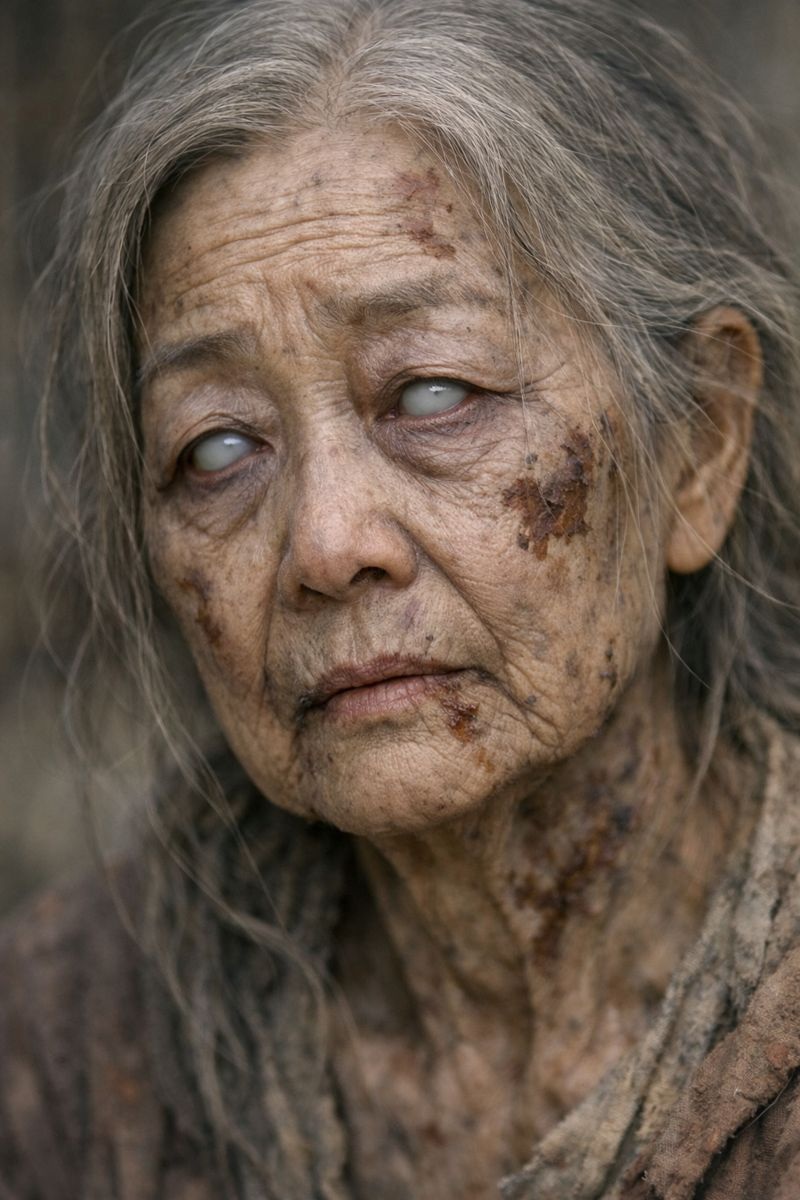
There is a sharp contrast between the young and the old in South Korea. Seoul at times feels like the offspring of 1950 and 2050, a child from the past and the future struggling with growing pains. There seems to be a symbiotic relationship between young and old, but like in the movie, the older population seems to be kept on the sidelines. This contrast between the past and the present is first seen in Train to Busan at the beginning of the movie when Seok Woo arrives home to his super modern and large high rise apartment where his mother also lives and takes care of the home and his daughter. In what may seem like an odd, even surrealistic scene to the western eye, the mother is picking through dried anchovies in the middle of the fancy living room. For Koreans, this scene is completely normal. The food culture in Korea is centered on traditional dishes that have been proudly inherited from previous generations. Traditional food and Korea are one and this is exacerbated by the millions of old men and women who are still alive and who know first hand the definition of hunger. The short anchovy scene and the conversations with his mother at the beginning, when she is coaxing him into reconciling with his wife, and later over the phone when she is turning into a zombie herself, emphasize the influence of the past on the present. Confucian values prioritize the importance of maintaining the unity of the family at all costs, and these values are prevalent in Korean society where “each person in the family still has a clearly defined role, each dependent on others within the family unit” (Sorensen). What happens when those roles are not fulfilled? What happens when those roles are questioned? For how long can one struggle with the decisions of the past and the repercussions on the present? Is it then guilt, longing, acceptance, or repentance that is seen in her eyes in the scene where the old woman, now a zombie, is looking through the train car into the car where her friend and the remaining passengers are seemingly safe? She is a zombie now, she should not be feeling anything but the hunger to turn others into zombies like her. Yet, Yeon makes sure to show us that this zombie is feeling like a human behind the hazy pupils. Her friend senses this and just before she joins her, in what sounds like the words one could whisper if a loved one was at the end of her life, she softly proclaims, “You have worked hard.” And they have. The old people of Korea have worked so hard all their lives and still do. There is no other developed country characterized by such a modern and futuristic setting where one can observe and have to accept as a cultural characteristic the amount of hard work performed by old men and women, some in their eighties or even older. In Seoul, for example, like if they were youngsters, one can see elders every single day doing physical work, like pushing carts with recycled boxes, selling produce at markets, or working in kitchens, like they were younger than the young. One wonders if director Yeon also thinks that, like the homeless, the elders of Korea are ignored and taken for granted and nobody would notice if they suddenly turned into zombies. By singling out the old woman, the only zombie that maintains a resemblance of her previous life, the creators of Train to Busan make sure to take a customary and deep, respectful bow in the presence of those who, for better or worse, for the right or wrong reasons, worked endlessly in hopes of a better future for the generations to come, in hopes that their children would not have to work and suffer as much as they did, as much as they do. In retrospect, Train to Busan, considered to be such a great zombie horror film, could after all actually been created with the goal of it being an intricate analysis of human nature and a social commentary on a nation that really has gone through seventy years of growing pains and will probably go through many more. This is why it is such a great movie, because “we are zombies of our history, not dead people whose wounds cannot be opened, because they were never closed” (Gimenez). Hopefully, interpretations of movies like Train to Busan and the conversations they trigger make us realize that if we do not become aware of our history, we only allow history to repeat itself. Hopefully, the majority of the conversations triggered by this movie end in agreement. The Land of the Morning Calm deserves to have future generations that can look back at its history with pride because there really has been a miracle after all. But the real miracle is not the rapid financial evolution that happened at the end of the 20th century; the real miracle is how South Korea has survived, not through these decades, but throughout the centuries. Its history is proof of a nation of resilient people who have been the target of powerful adversaries who treating them like zombies wanted to assimilate or annihilate them, yet here they are in the 21st century, not perfect, but determined to become the best version of themselves. The conversations resulting from this interpretation of Train to Busan will hopefully bring to mind that this is the time to build upon miracles using strong pillars of humanity, morality, decency, equality, ethics, justice, and compassion, and become a Busan, a beacon of hope for the rest of the world. *** © 2025 Julia Bellaflores MartinAuthor's Note
|
Stats
19 Views
Added on December 28, 2025 Last Updated on December 28, 2025 |


 Share This
 Email
Email Facebook
 Twitter
 Read Request
 My Library
 Subscribe
 Flag Writing