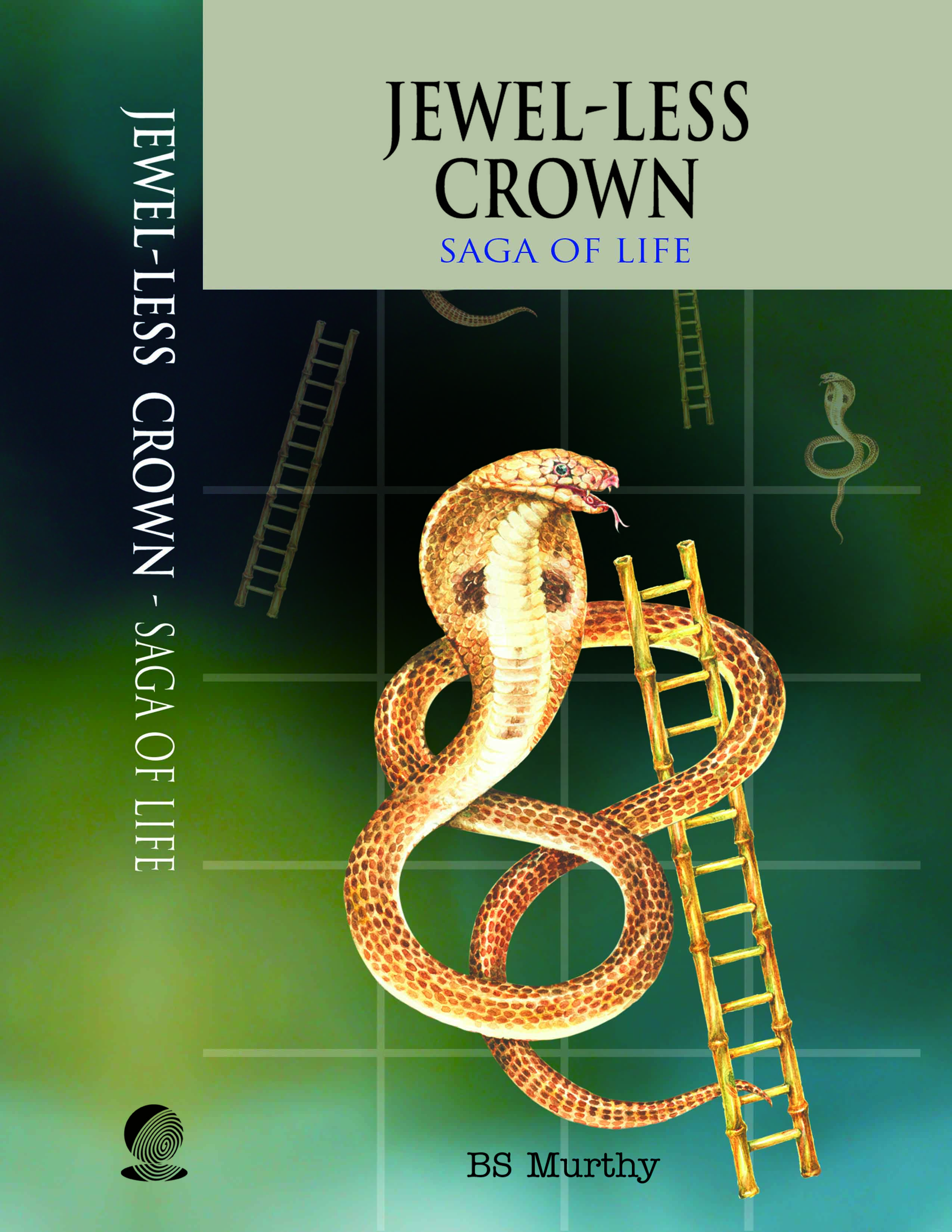
Domain of the DevilA Chapter by BS Murthy A satrical account of Indian publishing When at length, Suresh was finding his
moorings at Tihar; Subba Rau was brought in to a near stampede there. Why not,
the whole nation knew him by then as the man who had pricked at the Premier’s
face. When Suresh enquired what the fuss was all about, Rau said it was but a
‘literary coup’. Probed by Suresh for an account, Rau unfolded the story of his
life and times as an unpublished writer. In his mid-forties, Rau was seized with
an urge to bring himself onto the fictional stage. So to lend scope for his
boundless creativity, he chose the vastness of the ‘novel’ as the setting. And
for the medium of expression, he bypassed his mother tongue, Telugu, the
Italian of the East. Instead, he chose English not only for its ability to
nuance the complexities of life but also for the flair of expression he had in
it. Drawing from his examined life, he set out to portray a young woman’s life
on the male canvas of India. Ironically, it was his love for language
that impeded the start, but soon enough he got his poetic prose right for the
narrative in mind. With his creativity in command over the unique plot he
conceived, he wrote with gusto and had his dream novel for his debut in nine
months flat. After toiling for a while, for that ‘apart title’, he pitched in
for ‘Tangent of Fate’. Then, with a top-of-the-world feeling, he dispatched the
manuscript to a leading publisher in New Delhi. While he took the publisher for
granted, he received his manuscript post-haste. And that made him see the irony
of the title he had chosen for his novel! This bolt from the blue shook Rau to the
core, and he came to doubt his abilities as a novelist. Thus, holding the
manuscript, as one would his dead child, he had a last look at it, as the
father would, before the burial. But seeing it as crisp on its return as it was
when he had posted it, he felt cheated. As he realized that none at the
publisher’s end had an open mind, he saw the rejection letter all again. He
felt sad at the ungracious averment of unsuitability on the designer
letterhead. Impulsively, he felt like resubmitting
the manuscript with a rejoinder that the concerned editor could take her own
time to read and reject it, if it were a must. But, on second thoughts, he
realized that it would be treated as sour grapes, and thus kept his own
counsel. Anyway, he tried his luck with other Delhi publishers, this time, all
at a time. To his distress, it was like the quote of a cartel: Read your
manuscript with interest but found it unsuitable for our publication. As a last resort, in what was a reverse
phenomenon, he looked Westward for salvation, only to be informed that
unsolicited souls wouldn’t be baptized there. Though he felt it was cruel, he
thought it was an honest averment nevertheless. Could it be the unstated policy
of the Delhi operatives as well, he suspected, but, couched by the pretentious
unsuitability labels! To get a feel of the publishing scene
back home, he pored over the periodicals and the newspaper supplements in right
earnest. What amused as well as frustrated him was that while some publicized
the published titles to the hilt, the others debunked them as junk in the
reviews. Taking the reviewers seriously, he forwarded his manuscript to them,
indicating that it had all the ingredients they believed a novel should have in
it. And as none of them responded, he wondered whether the critics were more
interested in condemning a work than commending any. And, to find the pulse of the Indian
writing in English, he picked up some of the well-hyped novels. As he scanned
through them one by one, he was amused to find the two basic features of the
published kind: if it was not a case of the Western characters on the Indian
stage, then it must be the Indian Diaspora in the Western setting. It appeared
to him as though writing about the Indians in India was passé for the
publishing world. In that he saw a literary conspiracy �"
inducing Indian writers in English into churning out self-deprecating stuff to
cater to the prejudices of the Western readers. Well, the aspiring authors too
went along to provide vicarious pleasure to the Western readers by negating
India. That was why, realized Rau, the tent of the Indian novel in English laid
with the worn-out Western pegs in the loose native soil came flat at the
whimper of a scrutiny. When it came to the Diaspora produce, it was the wont of
the Western media to launch it in India in the haze of publicity to dazzle one
and all. Well, but, for a novel to impact its readers, it must be the soulful
tale of a people steeped in their native soil, isn’t it? But then, why the guys should go to such
lengths after all? Well, wouldn't have they sensed the potential of the myriad
hues of Indian life to shape fascinating pictures of fictional world? What if,
in time, some Mahabharata-like creativity resurged in Indian writing in
English? Would not the emerging Indian enterprise commercialize it by
inundating Western markets? If that were to happen, wouldn’t the public there
lap up the same and give up on the Western pulp fiction? So, reckoned Rau, the Western publishers
had set up shop here to avert that eventuality. And the tactic employed by them
was to encourage hybrid fiction through publication and dissuade the genuine
novel by its rejection. Understandably, Indian writers fell into the trap and
began inking hotchpotch on the Western dotted lines. Moreover, to ensure that
none deviated from the set course, the publishers had seen to it that the shape
they gave it became the norm of the Indian novel. This they could achieve by picturing
in the local media that the Indian writing in English was making waves
everywhere in the West. Yet, taking no chances, they would keep the bait
dangling by doling out hefty advance, on and off, to an odd insider to keep up
the farce. It was thus that, the vested interests of the West managed to nip in
the bud the genuine Indian novel in English, and averted its challenge to their
commercial writing. However, raising Rau's hopes, as some
literary luminaries projected themselves as Man Fridays of the budding authors;
he became expectant and felt the world of writing was not all that rough. But
when they too cold-shouldered him, he realized that they were only at
self-image building, knowing fully well that someone calling their bluff was
remote enough. Thus, he realized that the media was but a manifestation of the
make-believe at its best. Nevertheless, he philosophized that all could be
expected to be busy, getting on with their lives, besides pursuing their own
interests. He felt at length that it would be a futile exercise on his part to
seek help from any quarter. Just the same, the irony of the writers’
plight pained him. While the ‘hard to please’ editors reduced the aspirants to
the ranks of unpublished writers, the ‘harder to amuse’ reviewers seemed to
wait in the wings to turn the published ones into failed authors! Anyway, while
tending to debunk the book on hand, Rau had observed that most of the reviewers
aired their grandiose views on the book’s topic or tried to exhibit their
profound scholarship and/or both. It was as if the book under review provided a
stage for their literary exhibitionism! What distressed Rau most about the
reviewers though was the tendency of some to wonder why the book was written at
all! And it was in the advice of the reviewers that the author should cease
writing that he saw the hand of cruelty in the world of letters. He wondered
why they wouldn’t realize that their advice was inimical to their own
interests, for without books, where would be the need for reviewers? Wasn’t
there a felt need for the prevention of cruelty towards the writers? Above all,
the publishers and the reviewers alike appeared unconcerned about the hapless
readers for whose sake the show was supposedly run. It was then that he turned to God in
desperation. As though addressing his prayers, He appeared in his dream and
expressed His helplessness. God said that as publishing was in the devil’s
domain, there was nothing that He could do to help his cause. Thus, abandoning
his further forays into the publishing world, he decided that if he were ever
to write again, it would only be for the pleasure of writing, never mind the
publishing. When he could put his bitterness behind,
his muse moved him all again. Weaving a story in an intricate plot, he
completed his second novel in double quick time. It was as if his bottled up
creativity was too eager to find its way out. Naming it as the ‘Consigned
Conscience’, he nevertheless sent the manuscript to all the Delhi-wallahs
at one go, though with a sense of resignation. And as another subject with a
new dimension infused his urge to write, he plunged himself into his third
novel. As he was in the thick of action by the
time the expected rejections arrived, they failed to dampen his spirit. And,
one publisher’s missive that the theme was interesting but they wouldn’t be
interested in publishing the same amused him as well. And that made him wonder
as to how to write a theme-less wonder for their approval, that was, if they
were serious! When in time, he completed his third
novel; he realized that he was back to the reality of life. By then, however,
he realized that to be published, one needed either a reference or a
recognizable name. As he knew none who ever stepped into the corridors of a
publishing house, he thought, before submitting his fresh manuscript, it was an
idea to make a name for himself. Realizing that in the media world, the
divider between notoriety and fame was rather thin, he wanted to turn notorious
to help the cause of his writing. So he came to New Delhi, to be a part of the
crowd that greeted the Prime Minister on his birthday. With a rose with thorns
in his hand, he had no problem with the security personnel there. It was thus,
he found himself in the queue and waited for his moment. And when the Prime
Minister came near him, he pricked at his face with that rose of thorns. When
the security detained him for wrongful assault, the media picked up the story
to splash it on the front pages. And that gave him the much-wanted name,
didn’t it? Even before he could grasp the import of his notoriety, every
publisher in Delhi approached him to commission him into writing ‘Why I pricked
at the PM’s face!’ Though vindicated, he experienced the problems of plenty as
all pressurized him to sign for them. But, for sentimental reasons, he opted to
write for that book house, reading whose publications helped him mature into a
writer. Though he wrote his three novels at breakneck speed for they carried conviction,
he found himself struggling to put a sentence in place for the commissioned
work. When in the end, Suresh wanted to know
how he believed his rejected works were worth their effort, Rau said that it
was a good question, and mulled over for an answer. “If only you know,” said Rau, “why a
hand-to-mouth someone, neglecting his means of survival, wrote ten hours a day
for years on, that would answer your question. But as that is too abstract to
carry conviction, let me draw your
focus on my body of work. Well, all my novels were products of original
ideas from the plot downwards. Good or bad that makes them works of art. After
all, what is a novel but a creative idea that ever holds in the context?
Besides, the beauty of fiction in part is that it tends to lead towards the
fact.” “Why did you write the second and third
novels when there were no takers for the first one?” “In its essence, writing is primarily an
art of self-expression,” said Rau. “And about novel writing, didn’t Jane Austin
say that ‘in a novel the greatest faculties of human mind are on display.’ Only
after handling a couple or more themes would a novelist come to know about the
true capacity of his creative mind. Besides, of what worth is a novelist if he
fails to make each of his work unique in itself. But, the bane of the modern
world of letters is that many are writing though they have no business to write.
But with so many imitating the existing, or writing out of the libraries, there
is a surfeit of pseudo fiction. But, a novel is the brainchild of imagination
and not a hotchpotch of all that’s known. And it is this narrative routine that
makes the genuine readers skeptical about the novels in general. And that’s how
the classic novel and the genuine novelists have come to grief alike.” Finally, Suresh wanted to know how Rau
handled the failures. “The beauty of the endeavor obliterates
the ugliness of the rejection,” said Rau. “As I was ever engaged in trying, I
had no time to masticate my failures.” “All said and done,” said Suresh, “what
sense does it made of being a writer?” “If anything,” said Rau, “writing a book
is like planting a seed. And if it gets published, it’s like the sprouting of a
plant. If not, it’s a lonely furrow in a no-man’s land. Like the gardener tends
the plant into a tree, it’s the readers who help the book grow in stature.
Blessed are the authors who would be able to live long enough to smell that
their readers savored the fruits of their creativity. Oh, how that affords such
the emotional fulfillment associated with original writing and the ego gratification
that applause accords! And in spite of the media hype to the hilt, I'm not sure
if all the writer-celebrities derive the emotional fulfillment associated with
creative writing. Whatever, in my case, the pain of rejection made me immune to
frustration.” After having heard Rau, Suresh felt that
in the world of letters, the published and the unpublished writers, being free,
were alike condemned. Excerpt of the eponymous chapter in the author's free ebook, Jewel-less Crown: Saga of Life
© 2025 BS MurthyAuthor's Note
|
Stats
256 Views
Added on September 3, 2025 Last Updated on October 28, 2025 |


 Share This
 Email
Email Facebook
 Twitter
 Read Request
 My Library
 Subscribe
 Flag Writing