A Murder of CrowsA Story by Ed Staskus A Murder of Crows
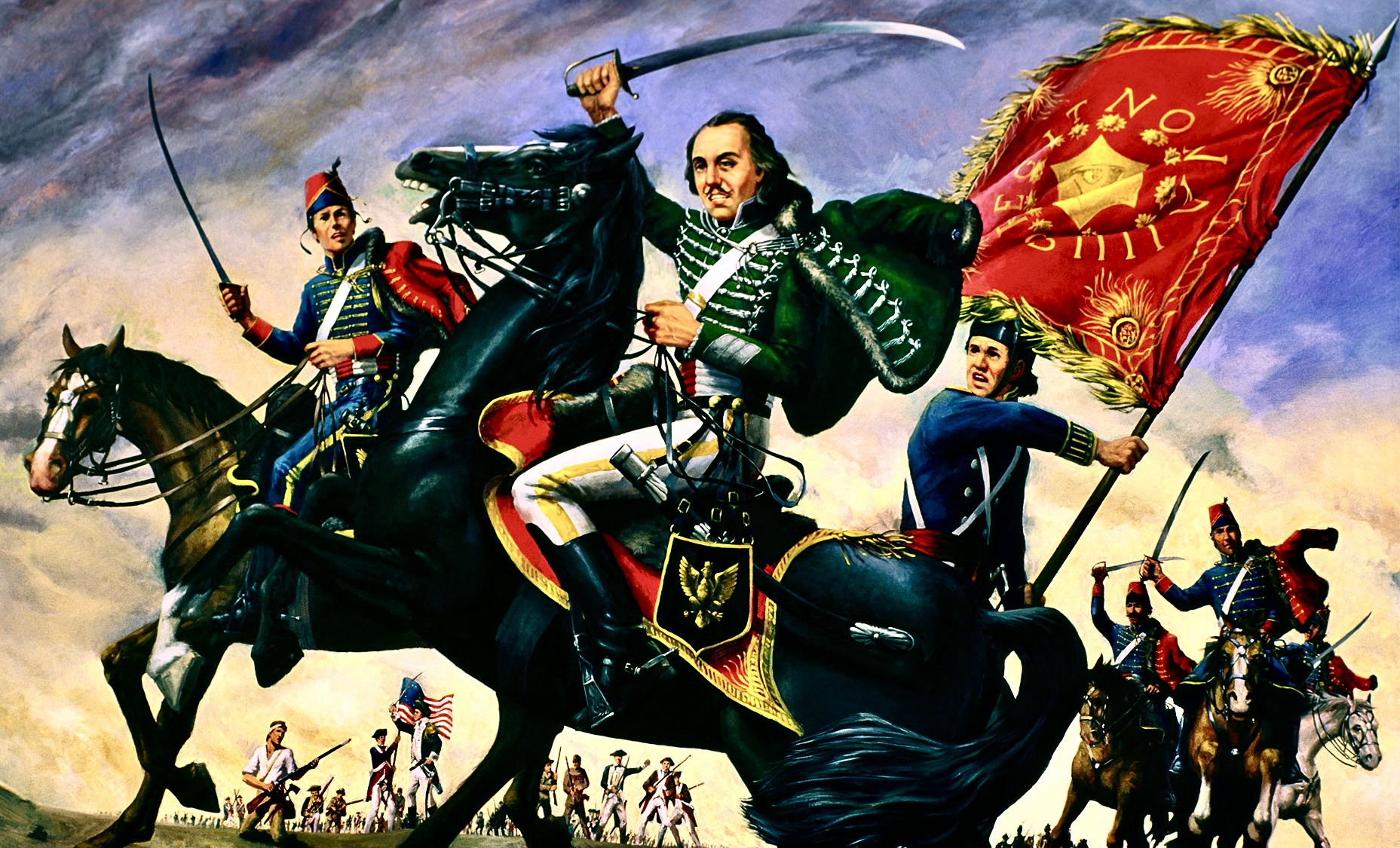
By Ed Staskus Michael Radzevicius had a bad feeling. He looked towards the Savannah River from where he was, which was a hillside north of the British fortifications, but couldn’t see it. There was a full moon somewhere but he couldn’t see that, either. It was a murky dawn. It was October 9, 1779. It was more than four years into the American Revolution. The British called it “The Present Unhappy Dispute.” There was a murder of crows in a nearby tree cawing every minute like clockwork. He would have liked to have eaten them for breakfast, but there was no time. When he was a child, working with his father fishing off the Baltic Sea’s Curonian Spit, he had caught and pickled crows for their winter rations. He had been known as a krahenbeiber for his skill in catching the birds and killing them by biting their skulls, which was quicker than trying to find a stone to bash them with. He didn’t like the gloom. Neither did his master’s horse. The horse flared his nostrils, snorting sharply. A flock of swallows was flying low to the ground. It meant it would probably rain soon. He looked up at the crows. There was only one left in the tree. Two crows meant good luck. One crow meant bad luck. Death was nearby. Michael was twenty two years old, fair haired and gray eyed. He was a Lithuanian who had grown up in the village of Juodkrante under Prussian overlords. He spoke Lithuanian and German, as well as some Polish. He was good with languages. His father didn’t understand where his son got his facility for speech. He only spoke one language and only spoke it when it was absolutely necessary. Michael Radzevicius’s master was Casimir Pulaski, a military man from Warsaw, the capital of the Polish Lithuanian Commonwealth. He came from one of most prominent szlachtafamilies in Poland. They were a warrior caste who rivaled the monarchy in power. He was seventeen years old when he entered military service. Two years later he got involved with an independence movement opposing Russian hegemony in the Commonwealth. He fought in several battles, eventually being captured. He was released in exchange for a promise that he would not again take up arms. He retracted the promise the second he was out of sight of the “predatory claws of Moscow.” In the spring of 1769, when he was twenty four years old, he defended the fort of Okopy Swietej Trojcy against numerically superior Russian forces, forcing them to lift their siege. That fall he left for Lithuania with six hundred men, hoping to incite further revolts against Moscow. He returned to Poland with four thousand men. One of the men was Michael Radzevicius. “I took up arms against the Czar to let him know a crown is just a hat that lets the rain in,” Michael said. He had nothing to lose. The Curonian Spit had slowly but surely been deforested in the past one hundred years. One day very strong winds and shifting sand dunes buried his village. His father suffocated inside their house. Their fishing boat sank in the storm. He fought with Casimir Pulaski at Jasna Gora Monastery and the Battle of Lanckorona. “He wasn’t interested in women or drink. All he wanted to do was fight.” Casimir Pulaski’s fighting days unraveled when he became involved in a conspiracy to kidnap Stanislaw August, the King of Poland and Grand Duke of Lithuania. The plot was compromised and failed. He fled Poland and sought refuge in France. “I had become his second by then, like a squire from the past. I made sure his weapons and horse were ready when needed. I had my own horse. I always fought beside him.” Casimir Pulaski spent 1775 in France. He was thrown into debtor’s prison, unable to pay his bills. When he was released he met Benjamin Franklin. “I am a soldier,” he said. “I fight when I am told. I win where I fight.” Benjamin Franklin recruited him to go to North America and fight in the Continental Army for the American Revolution. “Count Pulaski of Poland, an officer famous throughout Europe for his bravery and conduct in defense of the liberties of his country against the three great invading powers of Russia, Austria, and Prussia, may be highly useful to our service,” Benjamin Franklin wrote to the Continental Congress. “We sailed from Nantes up the Loire River into the Bay of Biscay. It only took us six weeks to reach Boston. There were no storms that summer.” When they got there Casimir Pulaski wrote a letter to George Washington. “I come here, where freedom is being defended, to serve it, and to live or die for it. Know that as I could not submit to stoop before the sovereigns of Europe, so I come to hazard all the freedom of America, and desirous of passing the rest of my life in a country free, and before settling as a citizen, to fight for liberty.” His first fighting was at the Battle of Brandywine in September 1777. When the Continental Army faltered, and a British battalion cut off George Washington and his staff’s retreat, threatening capture or death, he rallied a ragtag group of horsemen, charged the British, and averted a disaster, saving the commander-in-chief’s life in the process. A few days later he was commissioned as a brigadier general. “We fought in the Battle of Germantown, but after the weather got bad we found ourselves at Valley Forge for the winter.” Michael said. “It was a very hard winter. We were always hungry. There was never enough food.” . “We want wine above all things, for our sick are numerous, and our cases generally putrid,” James Fallon, a commissary agent, wrote to Jonathan Potts of the General Hospitals of the Northern Department. “We also want sheets, shirts, candles, soap, pots, horn-spoons, and every other kind of hospital utensil.” Most of the sick were tended at a nearby hospital in Yellow Springs. George Washington visited it in May 1778 and “spoke to every patient there, which pleased the sick exceedingly.” More than two thousand of the troops at Valley Forge died of disease that winter. Dr. Samuel Kennedy, the surgeon in charge of the hospital, died in June, just before the Continental Army left Valley Forge. Casimir Pulaski was put in charge of the Continental cavalry, an untrained and neglected branch of the army. Before his taking command they were only scouts and skirmishers. He reorganized and reformed them, organizing a training regimen and establishing a riding school. Pulaski’s Legion was made up of Americans, Germans, Frenchmen, and Poles. Their standard was a red banner. He wanted his men to be armed with lances. His request was denied. Swords and pistols were the order of the day. Their first action was at Egg Harbor on the New Jersey coast in October 1778. It didn’t go well. One of the Legion’s men had deserted to the British and given them intelligence about Casimir Pulaski’s movements and location. The British surprised them in their camp at the break of day and inflicted heavy casualties. The Legion retreated to Delaware, licking their wounds. “I learned to speak English soon enough, which pleased the Count.” It pleased Casimir Pulaski because he barely spoke a word of English. He spoke French, which hardly anybody in the Continental Army understood. He also swore in French. He was bull headed and swore a great deal. His men understood the vehemence, if not the words. “I became his interpreter. It was a thankless job more often than not. I didn’t translate what the men said about him.” Casimir Pulaski grew restless in Delaware. “He was angry about not being in the fight. He quarreled with his officers, usually about small matters, court martialing one of them over what he believed was an insult, even though it was nothing. He got into a face-off with our commanding officer, Anthony Wayne, who was just as quick to anger. The general, George Washington, finally sent us south where the British had shifted most of their forces.” They joined colonial forces defending Charleston, South Carolina. The city was in crisis. Pulaski’s Legion attacked the British but were outnumbered and mauled. Retreating to the city, Casimir Pulaski put his bad temper to work and rallied the city’s militia. They held out long enough to be reinforced by Major General Benjamin Lincoln. The British lifted their siege. “He got the lake fever while we were camped outside the city,” Michael said. Deaths from diseases like malaria, dysentery, and smallpox far exceeded combat deaths during the war. “But he stayed in the saddle. We were ordered to retake Savannah.” The British had captured the city in late 1778 as part of their Southern Strategy. Savannah was a crucial port city, vital to Georgia’s cash crops of rice and tobacco. The Legion rode to Augusta where they were to join forces with the French, who had entered the war on the side of the Americans. Casimir Pulaski took command of the combined calvary forces. The Franco-American siege of Savannah was intense, one of the bloodiest battles of the Revolutionary War. It was marked by trench warfare and artillery duels. The French unloaded cannons from their ships and bombarded the city for a week. “The appearance of the town afforded a sad prospect. There was hardly a house that had not been shot through.” The British were offered terms of surrender but politely refused. “The women and children have suffered beyond description,” an aide to Augustine Prevost, the general in command of the garrison, said. “Many poor creatures were killed trying to get to their cellars or hiding themselves under the bluff of the Savannah River.” Against advice from the Americans, and some of their own officers, the French launched a frontal assault on the morning of October 9th. Everything went wrong. A heavy fog rolled in. Troops got lost in the swamps. The redoubts outside the city, which the French believed to be defended by militia, were instead defended by British regulars. Redoubts were strongpoint fortifications lined with ditches and sharpened stakes. The Royal Engineers had put eight hundred slaves to work day and night constructing a twelve hundred foot long defensive line. Before the assault Casimir Pulaski said, “I long to die for such a true cause. I wish to expire on a bed of glory. I wish to perish at my post.” The frontal assault was a disaster. The attackers never got beyond the defensive line. “He was rallying French troops who had gotten disorganized,” Michael said. “He rode up and down the front line, shouting and waving his sword. He got too close to one of the redoubts where they had six-pound field guns. They were firing grapeshot.” It was ammunition made up of small iron balls packed into a heavy cloth bag and rammed down the barrel of a cannon. When the cannon fired the bag disintegrated and the iron balls, like a giant shotgun blast, shredded everything and everybody in its path. “He was struck in the leg and groin.” Michael Radzevicius wheeled his horse around and galloped to the fallen Count, scooping him up. “He was bleeding like a stuck pig.” He carried him off the field of battle. He got him aboard the Wasp, a merchant privateer’s ship. “He never woke up. He died two days later. We buried him at sea.” The Father of American Cavalry was dead at the age of thirty four. The Americans and French suffered nearly a thousand dead and wounded at Savannah. The British suffered less than two hundred dead and wounded. They held on to the port city until the end of the eight year conflict. They left after they lost the war. “I left the next day. It wasn’t my war. The only pay I had ever gotten was useless Continental script. There wasn’t any reason for me to stay. There was land to be had for the taking in the west, the kind of land I would never have come by in Lithuania. It was the future for me.” The Proclamation Line of 1763 had been drawn by the British, using the Appalachian Mountains as a boundary to restrict colonial settlement, separating them from Native American territories after the French and Indian War. Michael meant to cross that line. “The British beat us at Savannah, but they were going to lose the war. It was plain as day. Every time one of their redcoats or Hessians was killed, their replacement had to come from across the ocean. Every time a colonial was killed his replacement came from over the next hill. Their Proclamation Line was going to come to nothing.” Michael rode away from Savannah leading Casimir Pulaski’s horse, which he was using as a pack animal, panniers filled with gear and supplies. He had a compass and followed its needle pointing westward. He left his master’s sword and red banner behind. He became his own master. The road leading away from the battle was littered with dead men. He knew the crows would be at them the minute he passed by. He put their guttural croaks out of his mind as he rode towards the back country. Ed Staskus posts monthly on 147 Stanley Street http://www.147stanleystreet.com, Made in Cleveland http://www.clevelandohiodaybook.com, Down East http://www.redroadpei.com, and Lithuanian Journal http://www.lithuanianjournal.com. To get the site’s monthly feature in your in-box click on “Follow.” “Bomb City” by Ed Staskus “A police procedural when the Rust Belt was a mean street.” Sam Winchell, Beyond Books Cleveland, Ohio 1975. The John Scalish Crime Family and Danny Greene’s Irish Mob are at war. Car bombs are the weapon of choice. Two police detectives are assigned to find the bomb makers. Revenge is always personal. It gets personal. A Crying of Lot 49 Publication © 2026 Ed Staskus |
Stats
33 Views
Added on January 8, 2026 Last Updated on January 8, 2026 Author
Ed StaskusLakewood, OHAboutEd Staskus is a free-lance writer from Sudbury, Ontario and he lives in Lakewood, Ohio. His crime thrillers "Cross Walk" and "Bomb City" are available at Amazon. more.. |

 Share This
 Email
Email Facebook
 Twitter
 Read Request
 My Library
 Subscribe
 Flag Writing