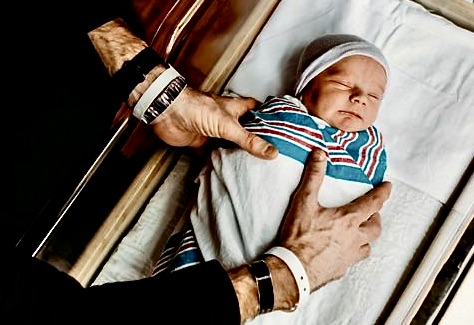
Shopping a BabyA Story by Ed Staskus Shopping a Baby
By Ed Staskus I was taking a walk around the perimeter of Madison Park across the street from the Lake Erie Screw Building when my Nokia rang. I was on my lunch break. It was practically the first call on my first cell phone. One of the guys in the warehouse called it a candy bar phone because it looked like a candy bar. All the top salesmen had gotten a cell phone earlier in the year. I wasn’t one of them. I wasn’t especially good at slapping backs and kissing babies. My brother, Rick, was the top salesman at Light Bulb Supply. Kevin and John were officially the barrow boys, but they were that by reason of being brothers of the woman who married the man who owned the company. It pays to be who you know. Rick was the moneymaker because he would do or say anything to make a sale. We sold everything related to light bulbs, from illumination to disinfection, from grow lights to tanning bulbs. Sales of tanning bulbs were going through the roof. Rick parked himself on that roof. He refused to take any calls that weren’t for tanning bulbs. When they came in he jumped on them like a hophead. I was taking a walk partly because I always did when the weather allowed and partly because I needed to cool off. Rick had told a tanning bulb customer who had come into our Will Call, a customer I had developed by phone, who was placing a seven thousand dollar order, that he was me. He wrote up the order and got the commission. The owner of the company didn’t care whose name was on the order so long as the check was made out to Light Bulb Supply. “I didn’t know he was yours,” Rick said. “Whatever you say.” I was rounding the swimming pool at Madison Park, on my way back to the Screw Building, when my new cell phone rang. I sat down on the lip of a water slide and answered the call. It was my sister Rita. She was calling from Born to Travel, the travel agency she worked at. “Can you drive dad and me to the airport tomorrow?” “Sure, I can arrange that.” “Thanks so much.” “Where are you going?” “Lithuania.” “Who is he visiting this time?” “He’s not, he’s going to buy a baby.” “He’s buying a baby?” “Not exactly, although he is going there to arrange for one.” “Mom and dad are a little old for a baby.” My mother was nearly seventy years old while my father was definitely in his early seventies. “It’s not for them.” “Is this like the head of Lenin that dad got for Russell Bundy?” “Kind of, but it’s not for him, it’s for his daughter.” Russell Bundy was a businessman from Urbana in southern Ohio. He operated a large manufacturing business, which was Bundy Baking Solutions. He had seven children. One of them, Beth, had married, but when she and her husband Joe decided to have a child, discovered they couldn’t. No matter what they tried they couldn’t negotiate a bun into the oven. Beth and Joe had tried finding a newborn to adopt in the United States, but it had proven to be difficult. There was a low supply of them and a high number of prospective parents. There was a long waiting list. They thought it might be easier to accomplish in Eastern Europe. Russell Bundy hired my father to smooth the way. Russell Bundy, my father, and my mother had made an exploratory visit to Lithuania a month earlier. My mother took an extra suitcase stuffed with jeans and cartons of cigarettes for our relatives. Russell Bundy took an extra suitcase full of candy. He passed the candy out at the orphanages they visited. The kids liked the candy, but he wasn’t able to strike a deal. My father found someone who could make it happen. He had been born and bred in Lithuania and knew his way around. “Dad calls her the Baby Middleman.” “l let you know when I have baby for you,” she told Russell Bundy. “How long will it take?” “Not long, you will see.” Russell Bundy flew back to his corner office in Urbana. My parents flew back to Cleveland. My father was tasked with seeing the business through. It didn’t take long. “I have baby for you, born yesterday,” the Baby Middleman told my father three weeks later. “You must come right away.” The baby cost twenty one thousand dollars. It amounted to eighty four thousand litai. The litas was Lithuania’s currency. The average annual wage in Lithuania was three thousand litai. The baby was costing twenty eight times the average annual wage in Lithuania. Russell Bundy wired the money. I drove Rita and my father to Hopkins International Airport. They flew off without incident. I went back to selling light bulbs. A month later Rita and I were at our parent’s house having dinner. My mother had made koldunai, which are Lithuanian dumplings smothered in bits of bacon and spoonfuls of sour cream. They were what we had grown up on. “Did you get a baby for Bundy?” I asked. “It wasn’t easy, but we got her,” Rita said. “What wasn’t easy about it?” “Dad and I flew to Vilnius and we went straight to the hospital. Beth and Joe were coming in a few days so we wanted to get everything arranged. The hospital was Soviet style, shabby and depressing. We parked in the back.” A group of male nurses were smoking Balomorkanals outside the door. The cheap tobacco was at one end of the cigarette and at the other end was a hollow cardboard tube through which to suck the smoke. “They looked me up and down. I remember thinking, I’m just going to act cool. We asked for the doctor we were supposed to see. She was small, gray haired, with lots of wrinkles. She told us the mother had given birth one day and slipped out of the hospital the next day. She left the baby behind. Dad and she talked some more and then she asked me why I hadn’t made a baby for our American friends.” “That’s a strange question to ask a total stranger.” “I didn’t know what to say, so I said, I’m only along for the ride. Dad asked to see the baby but the doctor said no. I thought, uh-oh, there is no baby. It was tense but she finally brought it. She was wrapped up like a mummy. Only her little head was sticking out. The doctor wouldn’t let us hold her. Maybe she thought we were going to run away with her. Then she started telling dad that another couple from Denmark wanted the baby and they were willing to pay extra. They had volunteered to buy some equipment for the hospital. Dad didn’t like that. He said, wait a minute, but she wouldn’t let it go.” “How much do you want?” my father finally asked. Before he retired he had been a certified public accountant. He knew when to get down to brass tacks. “She wouldn’t say it out loud, no matter how many times he asked her, so dad pushed a notepad towards her.” “Why don’t you write down how much this equipment is going to cost,” he said. “She wrote it down, dad looked at it, stood up, and slammed the notepad down on the table. No, that’s not right! We agreed on a price. We paid the price. We’re not paying any more. He was so angry.” They were staying at the Sarunas Hotel in downtown Vilnius. The recently opened hotel was launched in 1992 by the famous Lithuanian basketball player Šarūnas Marčiulionis. It was where many foreign businessmen stayed when doing business in post-independence Lithuania. The country was busy transitioning to capitalism. “When we got to our room dad called the Baby Middleman but she didn’t answer her phone. He called over and over, pacing back and forth. He wore out the carpeting. He finally reached her late at night and told her what had happened.” The money Russel Bundy had wired had been wired to her. She was supposed to pay the hospital when the baby was delivered to Beth and Joe. My father reminded her that they had an agreement and that he had done his part. It was up to her to do her part. “Meet me at ten o’clock tomorrow morning at Canteen Broth,” she said. “It’s a café. Come alone.” The next morning, one of our uncles at the wheel of his car, his son beside him, and my father and Rita in the back seat, were sitting squeezed together in the small car at the curb of Canteen Broth. It opened at ten o‘clock. “The lady walked up to our car and dad rolled his window down. She looked at us one at a time. She pointed to dad and said ‘Just you.’ They went inside. They were inside so long I fell asleep. When they came out they were smiling. When they shook hands I thought, good, it’s done.” “Was it done?” “Yes, they got the baby, no problem. Dad didn’t tell me how it got accomplished.” Our father often kept things close to the vest. The next day, while Beth, Joe, and my father took care of the red tape, Rita went for a long walk around Vilnius. It was a cloudless day, warm and sunny. In the summer the sun sets at around ten o’clock. In the winter the sun sets at around four o’clock. It was summer. “Our uncle said to call him if I needed a ride back to the hotel. I walked all around the Old Town.” She went to see the Gediminas Castle Tower and the Gates of Dawn. The gate is one of nine leading into the city. It features an icon of the Virgin Mary and is a major site of Catholic pilgrimages to this day. Gates of Dawn is also the name of a classic Pink Floyd album. Fans of Pink Floyd make their own idiosyncratic pilgrimages. Rita asked two men standing on a street corner where the Church of Sts. Peter and Paul was. “One of them said it was that way. He turned to point that way and lost his balance. He reeked of vodka.” It was the middle of the afternoon. “He fell over and passed out. His friend stood there smiling and looking down at him.” She took a break and sat in the silence of the airy and bright nave. It was a classic Baroque church. Lithuanians were the last Europeans to convert from paganism to Christianity. It happened in the late 14rth century. Grand Duke Jogaila ordered it done for dynastic reasons. Nobody believed in the powers of the White Christ, at least not then. Monks and priests eventually put the fear of God in them. The church was built in the 17th century to commemorate a victory over the Russians and their expulsion from Vilnius. There were two thousand stucco figures inside the church. They glowed in the light pouring in through the high windows. None of them ever said anything about anything. “When I went to call our uncle I didn’t have any money for a pay phone. All I had was my credit card. I stopped at a shop. It was called Kavine.” The word means coffee in the native tongue. “I asked if I could use their phone, speaking in Lithuanian. The man behind the counter was reading a newspaper. He didn’t even look up when he said no. I went to another place, same thing, except this time the woman there said they didn’t have a phone, even though I could see a phone behind her. When I stopped into a third place I spoke English instead of Lithuanian. The man there said, ‘Anything you need.’ I was offered complimentary coffee and a pastry while I waited for the phone to become available.” Beth bought two pairs of footsie pajamas and a hat for the baby. Joe packed for their return trip. Rita packed her clothes and some souvenirs. They drove to Vilnius Airport. The terminal dated to the 1950s, built in a drab Stalinist style. There was already talk that it was a symbol of the past and had to be updated, the sooner the better. “Dad stayed in Lithuania for a few days while I flew back with Beth and Joe.” They flew from Vilnius to Helsinki to New York City to Cleveland. “Crossing the Atlantic I happened to be in first class with the baby. Beth and Joe were just behind me in coach. I could hear them. They were arguing about what was packed in their suitcases. It was one thing or another the whole flight. I found out later they argued all the time.” “What did they name the baby?” I asked, putting my fork and knife down and pushing my empty plate away. I dabbed a spot of sour cream from the corner of my mouth. “Hannah.” The name means grace in Hebrew and bliss in Arabic. It doesn’t mean anything in the Lithuanian language. “That’s s fine name,” I said. Ed Staskus posts monthly on 147 Stanley Street http://www.147stanleystreet.com, Made in Cleveland http://www.clevelandohiodaybook.com, Down East http://www.redroadpei.com, and Lithuanian Journal http://www.lithuanianjournal.com. To get the site’s monthly feature in your in-box click on “Follow.” “Bomb City” by Ed Staskus “A police procedural when the Rust Belt was a mean street.” Sam Winchell, Beyond Books Cleveland, Ohio 1975. The John Scalish Crime Family and Danny Greene’s Irish Mob are at war. Car bombs are the weapon of choice. Two police detectives are assigned to find the bomb makers. Revenge is always personal. It gets personal. A Crying of Lot 49 Publication © 2026 Ed Staskus |
Stats
29 Views
1 Review Added on January 18, 2026 Last Updated on January 18, 2026 Author
Ed StaskusLakewood, OHAboutEd Staskus is a free-lance writer from Sudbury, Ontario and he lives in Lakewood, Ohio. His crime thrillers "Cross Walk" and "Bomb City" are available at Amazon. more.. |

 Share This
 Email
Email Facebook
 Twitter
 Read Request
 My Library
 Subscribe
 Flag Writing