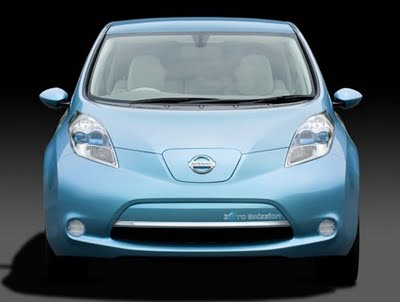
Back to the FutureA Story by Alex P. Cliché name, I know Several years ago, there was a phenomenon that gave humanity a solution to the fossil fuel dilemma. The electric vehicle was a fantastic idea for urban environments. It handled well, and it could get you from point A to point B on a single charge. Then, the conspiracy happened. The electric vehicle disappeared, covered up by large automotive businesses who thought it was a liability rather than an asset. The electric vehicle faded into the background, and people forgot about it. Until the threat of climate change and fossil fuel depletion became more widely known. Auto business began to invest in what became known as hybrids, vehicles that operate on both gas and electricity in order to conserve mileage and cut emissions. Then, people started talking about the electric vehicle once more. Opportunity presented itself once again to the concept of the electric vehicle, and this time, the auto industry snatched it up. Vehicles such as the Chevrolet Volt and the Nissan Leaf were manufactured, with other models quickly being constructed. Now it’s a race to see who can become greener, faster. I would really like to respond positively to the re-emergence of electric vehicles. I understand the environmental benefits of having an electric-powered mode of transportation, and I believe that EV’s will be useful in urban settings. Theoretically, there is nothing wrong with the production of these vehicles, and their approach to the global market should be a welcome relief. However, in North America, we have grown accustomed to speed, and the rush of activity that accompanies it. Since our evolution from horse-drawn carriages, we have been racing around at increasing velocities, with short time periods between during which we need to refuel. We are no longer used to waiting for anything. Everything in our lives is instant, and because of the advancing technology in receiving everything “now,” we have grown accustom to having no patience. The current mindset causes consumers to be wary of the seemingly low horsepower on these new EV’s, and complain that they would not be able to withstand the rigors of our fast-paced lifestyle without charging several times a day. However, EV’s are usually measured in kilowatts. 1 kilowatt is roughly 1.34 horsepower. When automotive commercials advertise that a vehicle has 300 horsepower, then they are saying that the vehicle has a maximum horsepower after several rotations per minute. With the electric vehicle prototypes currently on the market, their horsepower is not drawn from the rotations of an internal-combustion engine. The horsepower and torque they advertise can be used as soon as the driver puts their foot on the accelerator. The Obama administration is putting out $5 billion (USD) in tax credits, subsidized loans, and grants to ensure that auto makers work on ecologically friendly vehicles. It is also offering 4400 home-charging stations to individuals who buy electric vehicles, which are valued around $2000 per station, for absolutely no cost. For their own fleets, the government has put a bid in for 100 electric vehicles. It barely dents the 650,000 or more gas-powered vehicles they currently drive, but it is a step in the right direction, and may spur consumers to purchasing electric vehicles over gas-guzzlers. Alternatively, the California government is threatening to fine big automotive companies unless they produce zero-emission vehicle models by 2012.
© 2010 Alex P. |
Stats
113 Views
Added on November 16, 2010 Last Updated on November 16, 2010 |

 Share This
 Email
Email Facebook
 Twitter
 Read Request
 My Library
 Subscribe
 Flag Writing