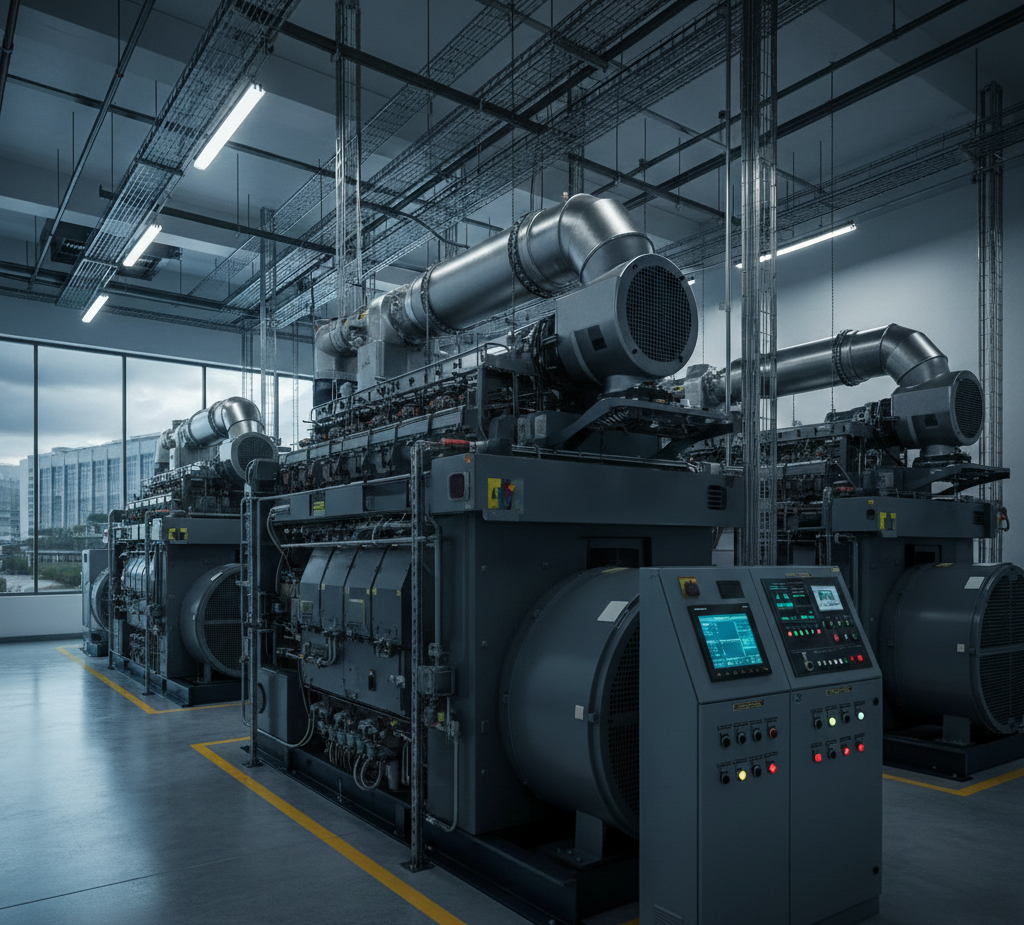
The Future of Data Center Power: Sustainability Meets ReliabilityA Story by Pujitha Reddy The data center generator market stands at a fascinating crossroads. The fundamental value proposition remains unchanged—these systems must deliver reliable power when the grid fails. The backbone of our digital world relies on an often-overlooked component: backup generators. As data centers continue their explosive growth worldwide, the market for these critical power systems is experiencing remarkable expansion. Industry projections suggest this sector will more than double in value over the next six years, driven by two seemingly contradictory demands�"the need for absolute power reliability and the urgent call for environmental sustainability. Market Growth and the Green Energy ChallengeThe intersection of exponential data growth and climate consciousness is reshaping how data centers approach backup power. With facilities consuming between one and three percent of global electricity, operators face mounting pressure to minimize their environmental impact while maintaining the ironclad reliability their customers demand. This challenge has sparked innovation across the industry. Traditional diesel generators, long the standard for emergency power, are being reimagined through cleaner fuel alternatives and intelligent management systems. The result is a fundamental shift in how the industry thinks about backup power�"not just as insurance against outages, but as an integral part of sustainable operations. The HVO RevolutionAmong the most significant developments is the adoption of Hydrotreated Vegetable Oil as a generator fuel. This renewable diesel substitute, derived from waste vegetable oils and animal fats, offers a compelling value proposition: it can directly replace conventional diesel without requiring hardware modifications, while substantially reducing carbon emissions. The technology has moved beyond pilot programs into mainstream deployment. Leading operators across multiple continents have embraced HVO, with facilities in Singapore, Europe, and the Americas either running on or transitioning to this sustainable fuel. One Middle Eastern operator has announced plans to convert their entire portfolio to HVO, designing all new generators with this capability from the ground up. The appeal is clear. HVO allows data centers to maintain their existing generator infrastructure while immediately cutting their carbon footprint�"a rare win-win in the sustainability equation. Intelligence at the Edge of PowerBeyond fuel innovation, the industry is experiencing a software revolution. Modern data centers are deploying sophisticated monitoring and management systems that bring unprecedented visibility and control to power infrastructure. These intelligent systems go far beyond simple alerts. Advanced analytics platforms now track performance metrics in real-time, predict maintenance needs before failures occur, and optimize power distribution dynamically. The integration of artificial intelligence and machine learning takes this further, enabling predictive management that can anticipate and respond to power demands with minimal human intervention. In regions like Latin America, where digital transformation is accelerating rapidly, the adoption of AI-powered infrastructure management has become a competitive differentiator. Companies using these advanced analytics solutions report improved efficiency and reduced operational risks. Capacity ConsiderationsThe generators themselves are evolving to meet changing demands. Mid-range capacity systems, typically producing between 1.5 and 3 megawatts, currently dominate installations. However, the emergence of hyperscale facilities is driving demand toward even larger systems�"those capable of delivering 3 megawatts or more. Colocation providers, who serve multiple customers from shared facilities, rely particularly heavily on high-capacity backup systems. For these operators, redundancy isn't optional�"it's the core product promise. Some facilities deploy generators in redundant configurations, ensuring that even if one system fails, customers never experience an interruption. The choice of fuel technology varies significantly by region. While European and American facilities increasingly favor natural gas and biofuel alternatives, data centers in Asia-Pacific and the Middle East continue to predominantly utilize diesel systems. This reflects differing regulatory environments, fuel availability, and the relative maturity of alternative fuel markets in each region. Geographic HotspotsThe global distribution of data center development reveals interesting patterns. North America, particularly the United States, remains the dominant market, accounting for more than half of regional demand. However, growth is far from limited to established markets. Latin American countries including Mexico, Chile, and Colombia are emerging as significant players. Europe shows strong concentration in Germany, the United Kingdom, and France, with Nordic countries gaining ground thanks to their cool climates and abundant renewable energy resources. The Middle East and Africa present a fascinating growth story. The UAE and Saudi Arabia lead regional development, but emerging markets like Oman, Bahrain, Nigeria, and Kenya are attracting substantial investment. Asia-Pacific demonstrates perhaps the most dynamic growth profile, with traditional powerhouses like China, Japan, and Singapore being joined by rapidly developing markets in Malaysia, Indonesia, and South Korea. Industry Leadership and InnovationThe competitive landscape features established industrial giants who bring decades of power systems expertise to the data center sector. These manufacturers are investing heavily in research and development, recognizing that the future belongs to those who can deliver both reliability and sustainability. Recent partnerships demonstrate the industry's commitment to green technology. In one notable example, a specialized distributor working with a major engine manufacturer delivered hundreds of HVO-compatible generators to data centers in a single year, providing over a gigawatt of standby capacity. Such large-scale deployments signal that sustainable backup power has moved from experimental to essential. Renewable IntegrationForward-thinking operators are looking beyond backup generators to address their overall energy footprint. Power purchase agreements with renewable energy providers have become a standard tool for major players committed to carbon neutrality. These long-term contracts fund solar, wind, and other renewable projects while securing predictable energy costs. Recent agreements include multi-year deals for solar power in Europe, with capacity measured in tens of megawatts. These arrangements allow data centers to claim renewable energy usage while supporting the broader build-out of clean energy infrastructure. The goal for many operators is clear: achieve net-zero carbon emissions within the next few decades. This ambitious target requires action on multiple fronts�"from adopting cleaner backup fuels to purchasing renewable energy to optimizing efficiency through better management systems. Looking AheadThe data center generator market stands at a fascinating crossroads. The fundamental value proposition remains unchanged�"these systems must deliver reliable power when the grid fails. But how they achieve that goal is being completely reimagined. The convergence of cleaner fuels, intelligent management systems, and renewable energy integration points toward a future where backup power systems contribute to sustainability goals rather than undermining them. As regulations tighten and customer expectations evolve, operators who successfully navigate this transition will be positioned to lead the industry forward. The numbers tell a compelling story of growth and transformation. But behind those statistics lies a more profound shift�"an industry learning to reconcile absolute reliability with environmental responsibility. That balance, once considered impossible, is becoming the new standard for data center operations worldwide. © 2025 Pujitha Reddy |
Stats
33 Views
Added on November 28, 2025 Last Updated on November 28, 2025 |

 Share This
 Email
Email Facebook
 Twitter
 Read Request
 My Library
 Subscribe
 Flag Writing