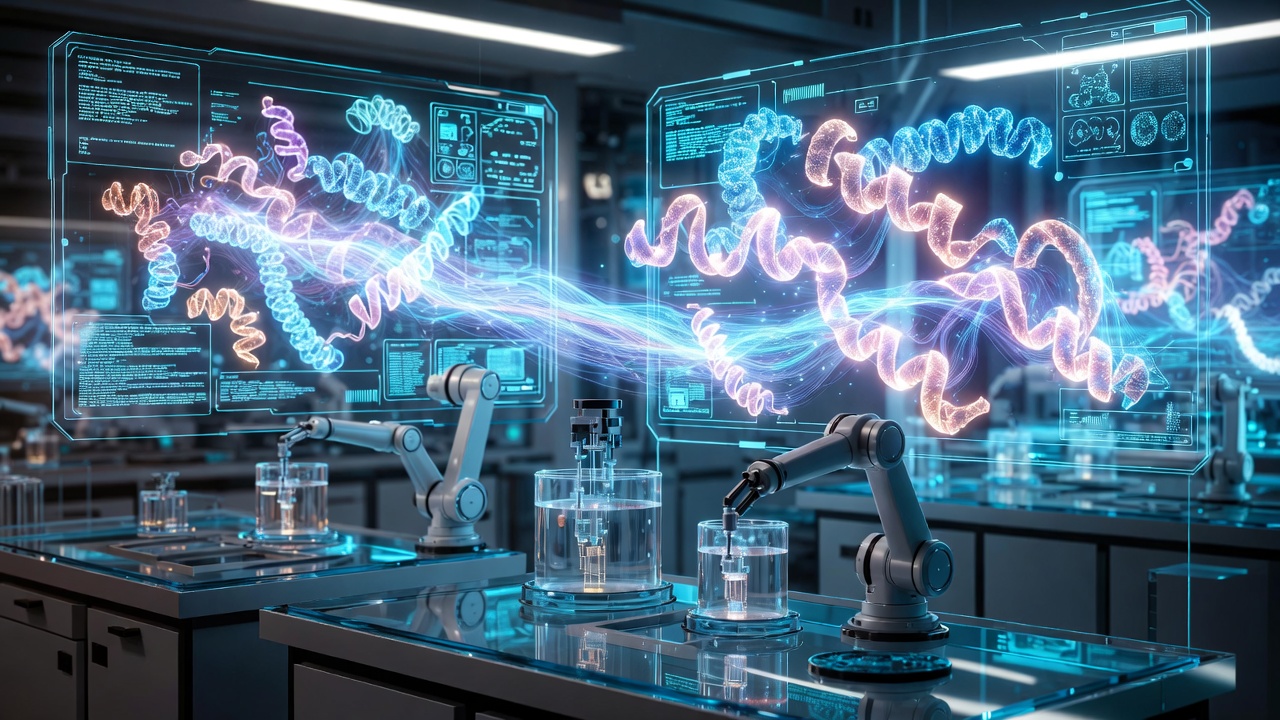
AI in Drug Discovery: Accelerating the Path from Lab to Lifesaving TreatmentA Story by Pujitha Reddy The integration of artificial intelligence into drug discovery exemplifies how transformative technologies can address longstanding challenges, creating value for industries while advancing human heal Pharmaceutical research has long been characterized by astronomical costs, lengthy timelines, and high failure rates. But artificial intelligence is rewriting these equations. With the AI in drug discovery market projected to leap from $1.71 billion in 2024 to $8.52 billion by 2030�"growing at over 30% annually�"we're witnessing a fundamental transformation in how medicines are developed. The Traditional Drug Discovery ProblemBringing a new drug to market traditionally costs billions of dollars and takes over a decade. The process involves screening thousands of compounds, predicting how molecules interact with biological targets, conducting extensive trials, and navigating countless dead ends. The failure rate is staggering, with most candidates never reaching patients. This inefficiency creates a bottleneck: urgent medical needs go unmet because the discovery process cannot keep pace with disease evolution. Rising R&D costs force pharmaceutical companies to be increasingly selective about which projects to pursue, potentially leaving important therapeutic areas underserved. How AI Changes EverythingArtificial intelligence attacks multiple bottlenecks simultaneously. Machine learning algorithms analyze vast datasets�"genomics, proteomics, clinical trial results, real-world evidence�"identifying patterns humans would never detect. These systems can predict which molecular structures might bind effectively to disease targets, estimate toxicity profiles, and optimize pharmacokinetics before synthesizing a single compound in the lab. Deep learning takes this further, using neural networks to analyze highly complex data like protein structures, disease pathways, and biomarker discovery. Google DeepMind's AlphaFold system revolutionized protein structure prediction, enabling researchers to understand molecular targets with unprecedented precision and speed. Generative AI: Designing Molecules from ScratchPerhaps the most exciting development is generative AI�"systems that don't just analyze existing compounds but design entirely new molecular structures optimized for specific therapeutic goals. These algorithms can generate novel drug candidates that meet multiple criteria: effectiveness against the target, favorable safety profile, appropriate absorption and metabolism characteristics. This capability dramatically expands the chemical space researchers can explore. Rather than screening libraries of known compounds, scientists can now design molecules purpose-built for specific challenges�"potentially discovering therapeutic approaches that would never emerge from traditional methods. Drug Repurposing: New Uses for Old MedicinesAI excels at identifying unexpected connections. By analyzing genomic data, clinical trial results, and real-world patient outcomes, AI systems can discover that existing drugs approved for one condition might effectively treat entirely different diseases. This drug repurposing approach offers enormous advantages: these compounds have already cleared safety testing, manufacturing processes are established, and regulatory pathways are clearer. This means faster, cheaper development for conditions that desperately need treatments. During the COVID-19 pandemic, AI-driven repurposing helped identify existing drugs that might combat the virus�"demonstrating the approach's value during health crises. The Data FoundationAI's power depends on data availability, and healthcare is generating data at unprecedented rates. Electronic health records, genomic sequencing, imaging studies, wearable sensors, and molecular diagnostics create massive datasets that would be impossible to analyze manually. Omics technologies�"genomics, proteomics, metabolomics�"provide detailed molecular portraits of diseases. AI integrates these diverse data types, revealing how genetic variations, protein expressions, and metabolic pathways interact to cause illness. This systems-level understanding enables more targeted, effective therapies. Personalized Medicine at ScaleCancer treatment exemplifies AI's impact. Oncological disorders represent the largest therapeutic area in the AI drug discovery market because cancer's molecular complexity demands sophisticated analysis. AI algorithms analyze tumor genomic and transcriptomic data to identify specific mutations driving individual cancers. This enables development of targeted therapies that attack cancer cells while sparing healthy tissue�"improving outcomes while reducing side effects. AI can even predict which patients will respond to which treatments, enabling truly personalized medicine. Cloud Computing and Computational PowerThe convergence of AI algorithms and cloud computing infrastructure makes this transformation possible. Training deep learning models on molecular data requires enormous computational resources�"far beyond what individual research institutions could afford. Cloud platforms democratize access to high-performance computing, enabling smaller biotech companies and academic researchers to leverage AI capabilities that were recently available only to major pharmaceutical giants. This accelerates innovation by expanding the pool of organizations pushing boundaries. Collaborative EcosystemsThe market is characterized by extensive partnerships between pharmaceutical companies and AI specialists. Established pharma firms like Pfizer, Novartis, Roche, and AstraZeneca collaborate with AI startups like BenevolentAI, Insilico Medicine, Atomwise, and Exscientia. AstraZeneca's partnership with BenevolentAI for target identification and drug repurposing exemplifies this collaborative model�"combining pharmaceutical domain expertise with cutting-edge AI capabilities. Technology giants like IBM Watson, NVIDIA, and Google DeepMind provide platforms and computing infrastructure that accelerate research. These partnerships acknowledge that successful AI drug discovery requires both deep pharmaceutical knowledge and advanced AI expertise�"rarely found within single organizations. Clinical Trial OptimizationAI's impact extends beyond lab research into clinical trials. Machine learning algorithms analyze patient data to identify optimal trial candidates, predict individual responses, and reduce dropout rates. This improves trial efficiency while potentially enabling smaller, more targeted studies. Natural language processing mines scientific literature and clinical databases, extracting insights from millions of published papers�"knowledge synthesis that would take human researchers years. This ensures investigators build on existing understanding rather than duplicating efforts. Regional Leadership and GrowthNorth America dominates with over 43% market share, driven by advanced technology infrastructure, robust pharmaceutical sectors, and substantial R&D investment. The U.S. hosts leading AI companies, research institutions, and pharmaceutical giants creating a powerful innovation ecosystem. Europe maintains significant presence through strong research networks, public-private partnerships, and supportive regulatory frameworks. Countries like Germany, France, and the UK lead European efforts with thriving biotech industries and state-of-the-art facilities. Asia-Pacific is experiencing exponential growth, fueled by government support and healthcare investments. China's "Next Generation Artificial Intelligence Development Plan" prioritizes AI integration across healthcare, while Japan and India pursue national AI strategies boosting drug discovery innovation. Addressing Chronic Disease BurdenThe rising prevalence of chronic diseases�"cancer, diabetes, cardiovascular disease, neurodegenerative conditions�"creates urgent need for new treatments. AI enables rapid identification of drug candidates and accelerates development of personalized therapies addressing these complex conditions. Traditional discovery methods struggle with chronic diseases' molecular complexity. AI's ability to integrate multi-omic data and identify subtle patterns offers hope for conditions that have resisted conventional approaches. The Path ForwardAs AI technologies mature and integrate more deeply into pharmaceutical pipelines, the potential to deliver safer, more effective therapies faster and cheaper is becoming reality. Small molecule drugs currently dominate, but biologics�"monoclonal antibodies, vaccines, gene therapies�"are gaining traction as AI optimizes their development. Regulatory frameworks are adapting to AI-driven development, creating pathways for approving drugs discovered through these novel methods. As confidence in AI predictions grows and validation studies accumulate, regulatory acceptance will accelerate adoption. The transformation isn't without challenges: data quality and standardization, algorithm transparency and interpretability, regulatory uncertainty, and integration with existing workflows all require attention. However, the trajectory is clear�"AI is becoming integral to pharmaceutical research. ConclusionAI in drug discovery represents more than incremental improvement�"it's a paradigm shift in how humanity develops medicines. By dramatically reducing costs, accelerating timelines, and enabling personalized approaches, AI addresses fundamental limitations that have constrained pharmaceutical innovation for decades. The market's explosive growth reflects recognition that this technology isn't futuristic speculation�"it's delivering results today. For patients awaiting treatments, for pharmaceutical companies seeking efficiency, and for healthcare systems managing costs, AI-driven drug discovery offers compelling promise: faster development of better medicines at lower costs. The convergence of advancing algorithms, expanding datasets, increasing computational power, and collaborative ecosystems is creating conditions for sustained innovation. The next decade will likely see AI become standard practice across pharmaceutical research�"fundamentally changing what's possible in medicine. © 2026 Pujitha Reddy |
Stats
27 Views
Added on February 16, 2026 Last Updated on February 16, 2026 |

 Share This
 Email
Email Facebook
 Twitter
 Read Request
 My Library
 Subscribe
 Flag Writing