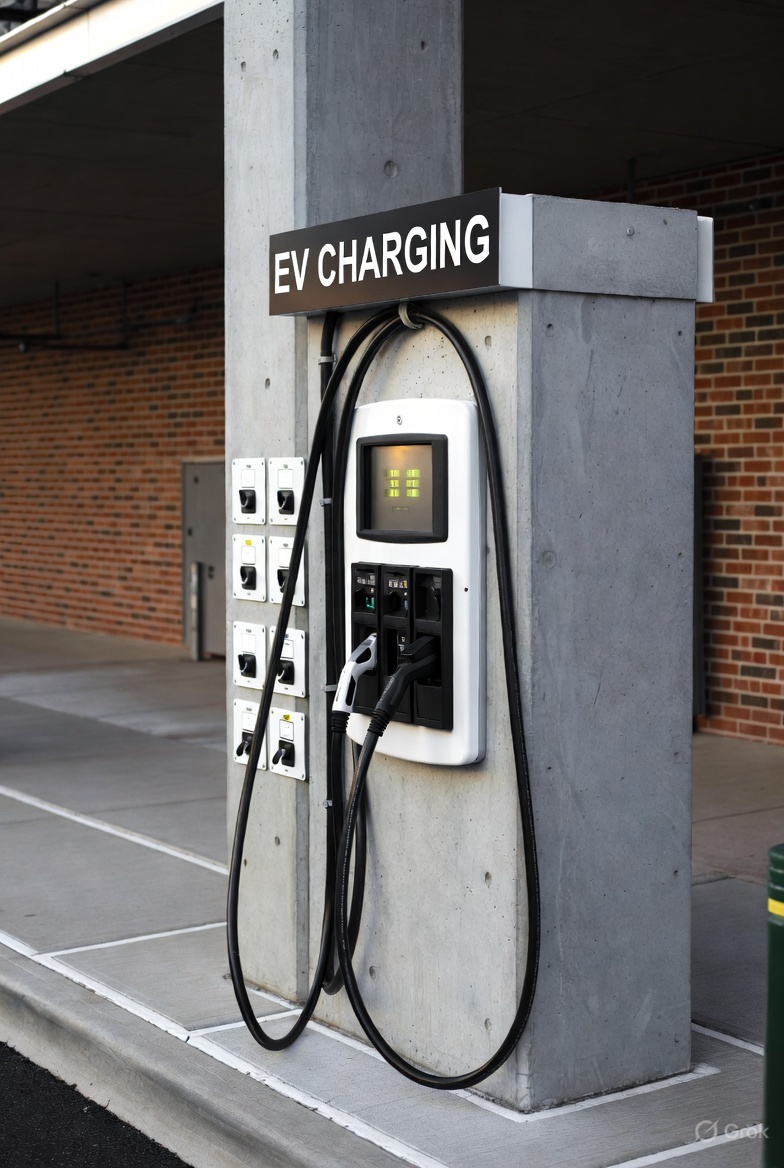
Plugging Into the Future: The EV Charging Equipment Market Is AcceleratingA Story by Pujitha Reddy Range anxiety and charging convenience remain the two biggest psychological barriers to EV adoption. Every new charger installed chips away at both. The shift to electric vehicles is well underway �" but EVs are only as practical as the infrastructure that supports them. That's why the global EV charging equipment market is emerging as one of the most consequential investment stories of the decade. Valued at around $20.7 billion in 2023, it's on track to more than double to $46 billion by 2029. Know More : https://www.arizton.com/market-reports/ev-charging-equipment-market What's Driving the ChargeThe growth story here isn't complicated. More EVs on the road means more demand for places to charge them. But several forces are converging to accelerate that demand well beyond a simple supply-and-demand equation. Government policy is playing a leading role. Tax credits, installation subsidies, and regulatory mandates for expanding charging networks are creating a strong financial case for infrastructure investment. Norway offers a striking example �" EV owners there benefit from reduced tolls, discounted ferry fares, and significant tax exemptions, making the economics of EV ownership compelling and driving charging infrastructure demand in turn. Corporate fleets are another growing demand source. As businesses electrify their vehicle fleets, the need for reliable, high-capacity commercial charging infrastructure is rising sharply alongside it. The Technology Reshaping the MarketOne of the most exciting developments in the space is Vehicle-to-Grid (V2G) technology. Rather than simply drawing energy from the grid, V2G-enabled EVs can push excess power back into it �" essentially turning every EV into a mobile energy storage unit. This two-way flow helps grid operators manage peak demand, and it can lower energy costs for EV owners in the process. As EV adoption scales globally, V2G represents a meaningful opportunity to enhance grid stability. India alone is targeting 500 GW of renewable energy capacity by 2030, with expectations that 40% of new vehicle sales will be electric �" a scenario where V2G could play a major stabilizing role. Software is also becoming a critical differentiator. While hardware still commands the largest market share, charging software �" covering user apps, payment systems, energy management, and smart grid integration �" is growing at a CAGR exceeding 14%. The intelligence layer on top of the physical infrastructure is what enables dynamic pricing, remote monitoring, and seamless user experiences. Who's Leading and WhereAsia-Pacific dominates the global market with over 56% share, anchored by China's massive infrastructure investments and government-backed EV incentives. Japan and South Korea are contributing advanced charging technologies, while India's FAME scheme is accelerating adoption at the grassroots level. North America is growing rapidly, supported by federal investment, a dense network of fast-charging stations, and the presence of major EV manufacturers. Europe follows with aggressive climate mandates and well-developed public-private charging networks, particularly in the Netherlands, France, and the Nordic countries. On the product side, AC chargers dominate the market today �" largely due to their cost-effectiveness and compatibility with existing grid infrastructure. Their suitability for overnight home charging at off-peak rates makes them the practical choice for residential users, who currently represent the largest end-user segment. The Competition Is IntensifyingThe market is highly fragmented, with a mix of specialized startups and global multinationals competing for share. Key players like ChargePoint, ABB, EVBox, Wallbox, and Kempower are expanding aggressively. In China, TELD operates a network exceeding 500,000 charging points �" a scale that illustrates just how quickly infrastructure is building in high-growth markets. Strategic partnerships are shaping the competitive landscape. ChargePoint and LG Electronics recently joined forces to combine software expertise with hardware manufacturing, while EVBox partnered with SMEG to deploy hundreds of fast chargers across France. The Road AheadRange anxiety and charging convenience remain the two biggest psychological barriers to EV adoption. Every new charger installed chips away at both. As renewable energy integration deepens, smart charging technology matures, and investment flows into underserved regions, the EV charging equipment market will continue to be one of the defining infrastructure stories of the clean energy transition. The plug is in. The current is building. © 2026 Pujitha Reddy |
Stats
25 Views
Added on February 26, 2026 Last Updated on February 26, 2026 |

 Share This
 Email
Email Facebook
 Twitter
 Read Request
 My Library
 Subscribe
 Flag Writing