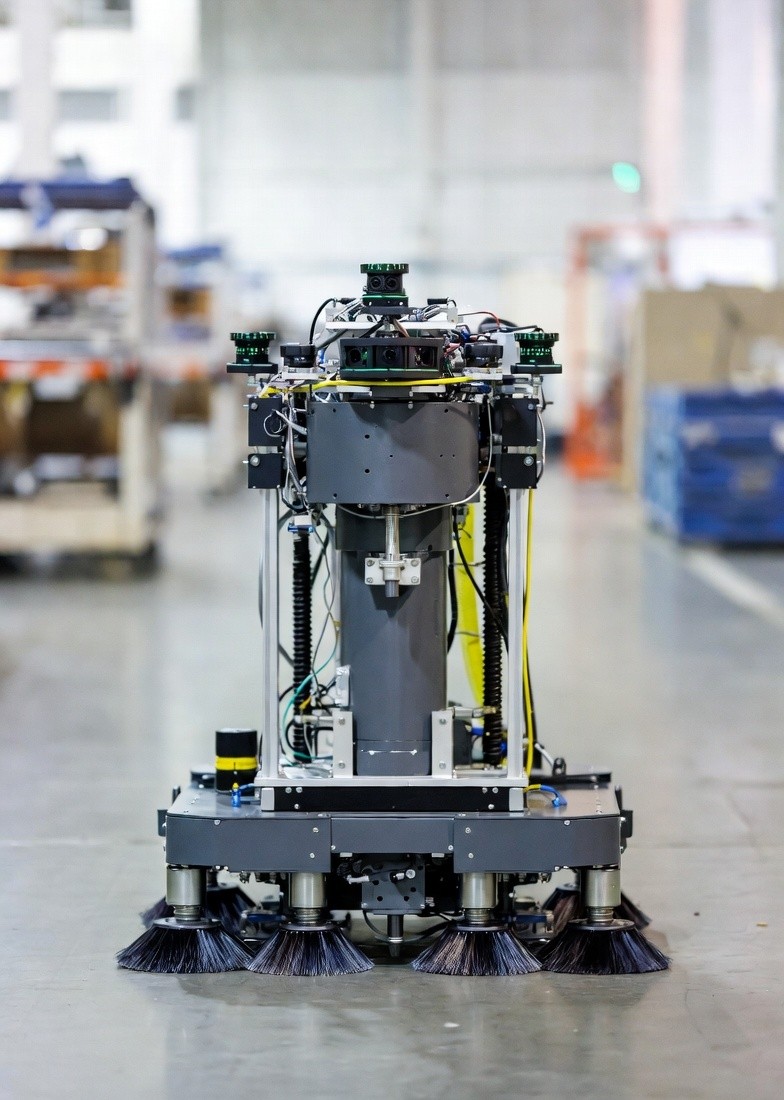
Rise of the Machines: How Robotic Floor Cleaners Are Transforming Industrial FacilitiesA Story by Pujitha Reddy The global industrial robot floor cleaner market, valued at $1.34 billion in 2024, is on track to reach $2.25 billion by 2030 — growing at over 9% annually. What's fueling this surge? A Quiet Revolution UnderfootWalk through a modern airport, warehouse, or hospital today and you might notice something unusual rolling quietly past �" no operator, no bucket, no mop. Industrial robotic floor cleaners are becoming a familiar sight in large facilities around the world, and the market behind them is growing fast. Valued at $1.34 billion in 2024, the global industrial robot floor cleaner market is expected to nearly double, reaching $2.25 billion by 2030 at an annual growth rate of over 9%. This isn't just a technology trend �" it reflects a fundamental shift in how businesses think about facility management, labor, hygiene, and sustainability. Know More : https://www.arizton.com/market-reports/industrial-robot-floor-cleaner-market Why Now? The Drivers Behind the BoomSeveral forces are converging to make robotic floor cleaners not just attractive, but in many cases necessary. Labor shortages and rising costs are pushing facility managers to rethink how cleaning gets done. In sectors like logistics, healthcare, and retail �" where staffing is both critical and chronically difficult �" autonomous machines that operate around the clock without breaks or sick days are increasingly hard to ignore. Stricter hygiene standards are also playing a role. Post-pandemic, cleanliness expectations in hospitals, food manufacturing plants, and public spaces have been ratcheted up significantly. Robotic systems offer a level of consistency and documentation that human crews simply cannot match at scale. The e-commerce explosion is another accelerant. With global e-commerce projected to exceed $6.88 trillion by 2025, warehouses are multiplying in size and number �" and every square meter of floor space needs to be kept clean to meet operational and safety standards. Robotic cleaners are stepping in to fill that gap, particularly in regions like Asia, North America, and Europe where warehouse automation is most advanced. Finally, smart building and sustainability goals are driving adoption. Modern robotic cleaners run on electricity, consume significantly less water and cleaning solution than traditional equipment, and operate quietly �" making them a natural fit for organizations pursuing green building certifications or ESG commitments. What Technology Is Making This Possible?Today's robotic floor cleaners are a far cry from the rudimentary automated machines of a decade ago. Artificial intelligence and machine learning have transformed these systems into genuinely intelligent operational tools. Advanced navigation using LiDAR sensors, ultrasonic detectors, and AI-powered vision allows robots to build accurate maps of their environment, adapt to dynamic obstacles in real time, and optimize their cleaning routes autonomously. Cloud-connected fleet management means facility managers can monitor performance, schedule tasks, and receive predictive maintenance alerts remotely �" across an entire network of machines. The trend toward all-in-one platforms is equally significant. Rather than deploying separate machines for sweeping, scrubbing, and drying, facilities can now use a single compact unit that handles multiple tasks across different floor surfaces. This is particularly valuable in space-constrained environments like hospitals or schools where operational disruption needs to be minimized. Some deployments are already showing measurable results. Hospitals using AI-driven robotic cleaners have reported reductions in infection rates, while logistics operators are citing meaningful decreases in total cleaning costs �" in some cases up to 25% �" thanks to optimized water usage, intelligent battery management, and lower labor dependency. Where Are These Robots Being Used?The retail and shopping sector led the market in 2024, generating over $320 million in revenue. High footfall, consistent hygiene requirements, and the need for discreet, around-the-clock operation make retail environments particularly well-suited to robotic cleaning. Manufacturing came in second, driven by automation mandates and environmental controls in sensitive facilities like semiconductor plants. Healthcare, education, airports, and logistics warehouses are all close behind �" each with their own compelling reasons to embrace autonomous cleaning. Government support is also accelerating uptake. Initiatives like the U.S. Department of Energy's smart manufacturing programs, India's Production Linked Incentive scheme, and Europe's Horizon-funded AI and robotics projects are channeling public investment into automation �" and robotic cleaning is benefiting alongside heavier industrial applications. The Barriers That RemainDespite the strong growth story, the market isn't without friction. The most significant obstacle is upfront cost. An industrial robotic floor cleaner can cost four times more than a conventional scrubber, which makes the business case harder to justify for smaller businesses, particularly in emerging markets where labor remains relatively affordable. Conventional walk-behind and ride-on scrubbers also aren't going away anytime soon. In cost-sensitive regions and labor-rich environments, traditional equipment still holds the advantage �" it's cheaper, simpler to operate, and widely available. Winning over this segment of the market will require the industry to either bring prices down or make the ROI case more compelling for smaller operators. A Fragmented but Fast-Moving MarketThe competitive landscape is notably fragmented �" the five largest vendors together account for only around 13% of global market share. That fragmentation reflects a diverse ecosystem of multinational manufacturers and regional innovators, each targeting specific sectors and geographies. Companies like Avidbots, Gaussian Robotics, Nilfisk, and TASKI are competing intensely on technology, with AI navigation, app-based controls, automated docking and refilling, and integration with building management systems becoming key differentiators. The race to build the most capable, most energy-efficient, and most cost-effective cleaning robot is very much underway. © 2026 Pujitha Reddy |
Stats
27 Views
1 Review Added on March 2, 2026 Last Updated on March 2, 2026 |

![[send message]](http://slow.writerscafe.org/images/mail.png)
![[befriend]](http://slow.writerscafe.org/images/friend.png)

 Share This
 Email
Email Facebook
 Twitter
 Read Request
 My Library
 Flag Writing