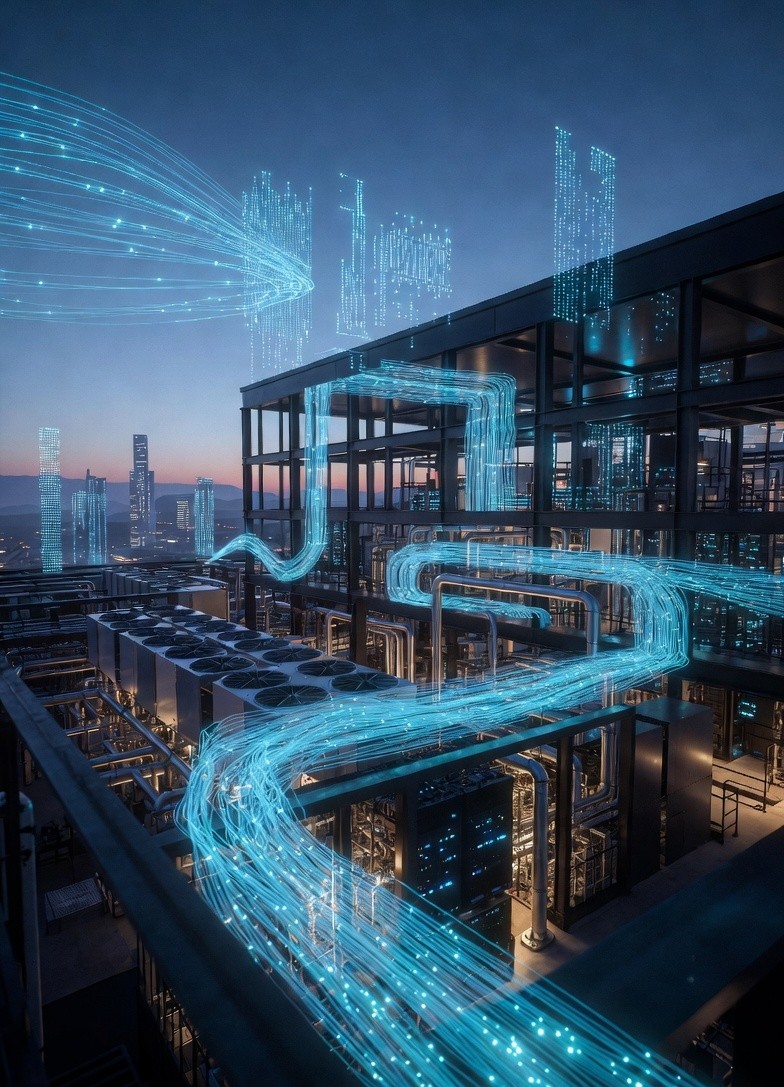
Liquid Cooling: The Technology Keeping AI Infrastructure from OverheatingA Story by Pujitha Reddy Liquid cooling is redefining data center infrastructure. Explore how AI workloads, immersion cooling, and sustainability goals are fueling a 51.93% annual market growth through 2030. A Market Growing at Extraordinary SpeedThe numbers are hard to ignore. The global data center liquid cooling market, valued at $870 million in 2024, is projected to reach $10.70 billion by 2030. That represents a CAGR of 51.93% and an absolute growth of over 1,100% across the forecast period. Few technology markets anywhere in the world are growing this fast, and the reason is straightforward: the computing infrastructure powering artificial intelligence is generating heat at a scale that traditional cooling simply cannot manage. As AI chips, GPU clusters, and high-performance computing workloads push power densities to new extremes, liquid cooling has shifted from a niche specialist solution to a foundational requirement for modern data center design. Know More : https://www.arizton.com/market-reports/data-center-liquid-cooling-market Why Air Cooling Is Losing the BattleFor decades, air cooling served the data center industry well. But the physics of air cooling have a ceiling, and the industry is hitting it fast. In high-performance servers, fans can consume between 10% and 20% of total system power, a significant overhead that grows as thermal loads increase. As chips approach their maximum operating temperatures, the engineering response typically involves larger heat sinks, higher airflow rates, and wider component spacing. All of these approaches limit how densely servers can be packed into a rack. For hyperscale operators running AI training workloads that require hundreds of kilowatts per rack, the constraints of air cooling are not theoretical. They are an operational reality that is directly limiting performance, increasing energy costs, and raising carbon emissions. Liquid cooling resolves these constraints by bringing thermal management directly to the heat source, enabling much higher rack densities, lower fan usage, and more efficient overall facility performance. Two Technologies Leading the TransitionTwo liquid cooling approaches are driving the majority of market investment: direct-to-chip cooling and immersion cooling. Direct-to-chip cooling, also known as cold plate cooling, circulates liquid through plates attached directly to CPUs and GPUs, absorbing heat at the processor level before it can radiate into the surrounding air. This approach is compatible with existing rack architectures, making it the most widely deployed liquid cooling technology today. It improves power usage effectiveness, reduces reliance on fans, and enables higher chip performance through more consistent thermal management. Immersion cooling takes a more radical approach. Servers are submerged entirely in non-conductive dielectric fluids that absorb heat directly from components across the entire system, not just at the processor. This method enables extreme rack densities and dramatically reduces the mechanical cooling infrastructure required to maintain safe operating temperatures. Immersion cooling accounted for approximately 17% of total market investment in 2024, and its share is growing rapidly as more AI-focused and high-performance computing facilities are built from the ground up with immersion in mind. Rear door heat exchangers play an important supporting role, capturing heat at the rack level without requiring major changes to existing infrastructure. Coolant distribution units are also becoming increasingly critical, managing fluid flow between IT equipment and external heat rejection systems to maintain consistent thermal performance at scale. Hyperscalers Setting the PaceGlobal hyperscalers are the dominant force behind liquid cooling adoption, and their influence on the market extends well beyond their own facilities. Apple, Google, Meta, Microsoft, and AWS are all investing heavily in direct-to-chip and immersion cooling technologies as they build the next generation of AI-optimized campuses. Their procurement decisions, design specifications, and technology partnerships are shaping the standards and expectations that cascade through the colocation and enterprise segments. Hyperscale facilities accounted for the largest share of total liquid cooling investment in 2024, driven by their need to support AI and HPC workloads demanding power capacities well in excess of 100 megawatts. Colocation providers accounted for approximately 36% of investment, reflecting the rapid deployment of GPU clusters and AI infrastructure by enterprise customers within shared facilities. Enterprise data centers are moving more slowly, but adoption is accelerating in sectors including financial services, healthcare, and research, where growing AI workloads are pushing hardware densities beyond the limits of air-cooled infrastructure. Hybrid cooling systems combining liquid and air-based approaches are expected to be the predominant enterprise model in the near term. Sustainability: Liquid Cooling as a Green Infrastructure ChoiceBeyond pure performance, liquid cooling is gaining traction as a sustainability enabler. By supporting higher chilled-water temperatures and enabling year-round free cooling in suitable climates, liquid cooling systems reduce the energy consumed by mechanical refrigeration. The ability to capture and reuse waste heat from liquid-cooled facilities for building heating or district energy networks adds another dimension to their environmental credentials. As data center operators pursue net-zero carbon targets and respond to tightening energy-efficiency regulations, liquid cooling has become a core pillar of sustainable infrastructure strategy rather than simply a performance upgrade. In regions with high electricity costs such as the Middle East and Latin America, the energy savings from liquid cooling also translate directly into operational cost reductions, strengthening the financial case for adoption alongside the environmental one. Regional DynamicsNorth America, led by the United States, dominates the global liquid cooling market, supported by the world's highest concentration of hyperscale and AI-focused data center capacity. Canada is in a growth phase, with significant investment expected over the next three years. Europe is advancing rapidly, particularly in the United Kingdom, Germany, and France, driven by stringent energy-efficiency regulations and expanding AI infrastructure investment. The Nordic countries of Norway and Sweden are also increasing their liquid cooling deployments, benefiting from cool climates that enhance the economics of free cooling. In Asia-Pacific, China leads with advanced deployments of both direct-to-chip and immersion cooling technologies. Japan, India, Australia, and South Korea are all accelerating adoption as AI workloads expand across the region. The Middle East, led by the UAE and Saudi Arabia, is emerging as a significant market. Extreme ambient temperatures make efficient cooling not just a sustainability preference but an operational necessity, and hyperscale investments across the Gulf are driving rapid adoption of high-performance liquid cooling infrastructure. The Competitive LandscapeThe vendor ecosystem is deep and growing more competitive. Specialist players including Asetek, Submer, CoolIT Systems, Iceotope, and LiquidStack are leading in immersion and direct liquid cooling solutions, with modular designs focused on high density and strong PUE performance. Major infrastructure providers including Vertiv, Schneider Electric, STULZ, Alfa Laval, and Johnson Controls are expanding their liquid cooling portfolios to offer more comprehensive thermal management solutions. Specialty chemical companies including Boyd, Castrol, Dow, and Lubrizol are advancing the performance and environmental profile of coolant fluids. Server manufacturers including Dell Technologies, HPE, Lenovo, and NVIDIA are accelerating the development of liquid-ready server architectures, making it easier for operators to deploy liquid cooling as a standard feature rather than a retrofit. Eaton's acquisition of Boyd Thermal in November 2025 signals growing industry consolidation as larger infrastructure players move to strengthen their positions across the liquid cooling value chain. The Road AheadThe data center liquid cooling market is at the beginning of a decade-long transformation. Growth will remain explosive through 2025 and 2026 as AI infrastructure investment accelerates, before moderating to a more sustainable annual rate of 13% to 15% by 2030 as the market matures and stabilizes. © 2026 Pujitha Reddy |
Stats
14 Views
Added on March 16, 2026 Last Updated on March 16, 2026 |

 Share This
 Email
Email Facebook
 Twitter
 Read Request
 My Library
 Subscribe
 Flag Writing