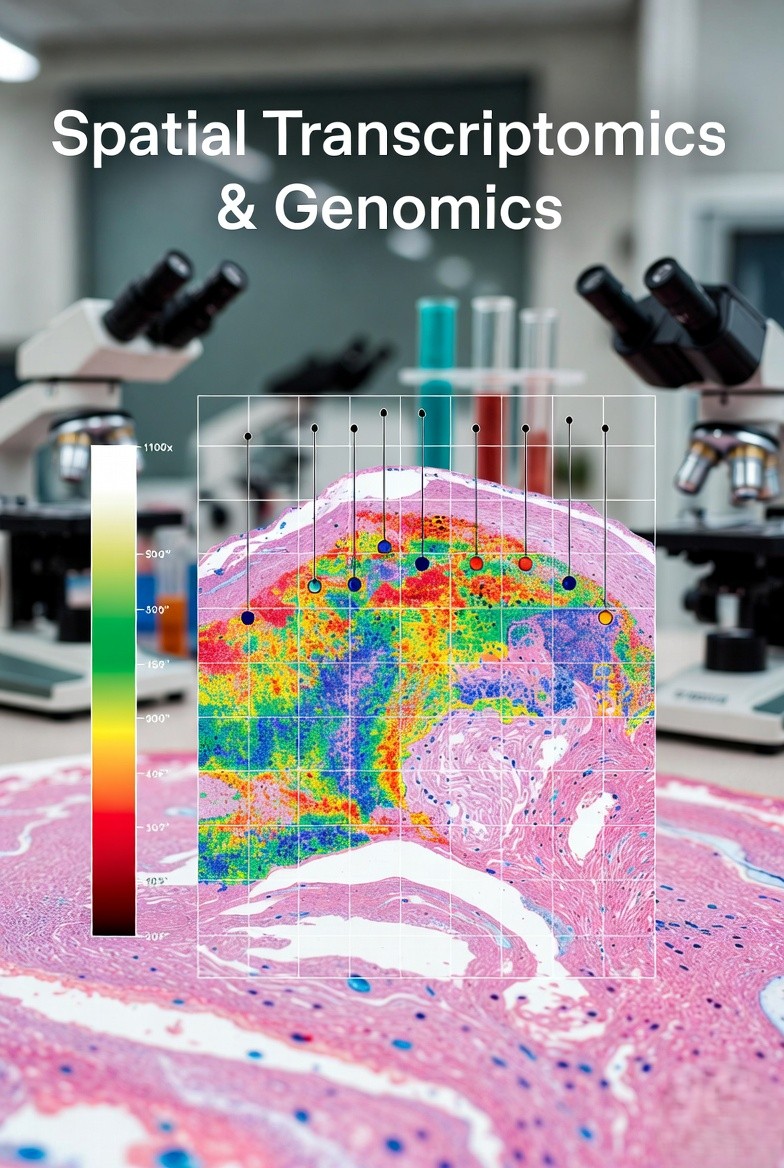
Mapping Biology in Space: The Rise of Spatial Transcriptomics and GenomicsA Story by Pujitha Reddy The spatial transcriptomics and genomics market is transforming biomedical research. Explore how cancer diagnosis, personalized medicine, biomarker discovery, and AI-driven analysis are fueling Science That Changes EverythingFor most of modern biology's history, studying gene expression meant grinding up tissue samples, losing in the process one of the most important dimensions of biological reality: where in a tissue a gene is being expressed, and in what relationship to surrounding cells. A tumor that looks uniform under a microscope may contain dozens of distinct cell populations with profoundly different behavior. A developing embryo's fate is shaped not just by which genes are active, but by the spatial relationships between the cells expressing them. Spatial transcriptomics and genomics technologies have solved this problem. They enable researchers to map gene expression and genomic activity within the preserved spatial context of tissues and cells, revealing the cellular geography of biology in a way that was simply impossible before. The global spatial transcriptomics and genomics market is experiencing rapid growth, driven by transformative applications in cancer research, neuroscience, drug discovery, and personalized medicine. Technological advances in high-resolution imaging, single-cell sequencing, and computational analysis are steadily expanding what the field can achieve and who can afford to apply it. Know More : https://www.arizton.com/market-reports/spatial-transcriptomics-and-genomics-market Cancer Diagnosis: The Most Compelling ApplicationPerhaps no application illustrates the transformative potential of spatial genomics more clearly than cancer diagnosis and research. Tumors are not uniform masses of identical cells. They are heterogeneous ecosystems containing cancer cells in various states, immune cells, stromal cells, and vascular components, all interacting in ways that determine whether a tumor grows aggressively, responds to therapy, or evades the immune system. Conventional biopsy and sequencing approaches destroy the spatial relationships between these cell populations. Spatial genomics preserves them, allowing oncologists and researchers to profile not just what genes are expressed in a tumor but where, in what cellular context, and in what relationship to other cell types. This precision has direct clinical implications. Identifying which regions of a tumor are likely to develop drug resistance, understanding the spatial distribution of immune cell infiltration, and mapping the boundary between invasive and non-invasive cancer cells can all inform more effective treatment planning. As the technology matures and becomes more cost-effective, its integration into routine oncology workflows is a realistic near-term prospect rather than a distant aspiration. Personalized Medicine: The Bigger VisionThe preference for personalized medicine is one of the most powerful market forces shaping spatial transcriptomics adoption. The recognition that patients with nominally the same diagnosis can have profoundly different molecular disease profiles, and therefore respond very differently to the same treatment, has been one of the central lessons of genomic medicine over the past two decades. Spatial technologies take this insight to the next level. By revealing not just a patient's genetic profile but the spatial organization of gene expression within their specific tissue architecture, these tools enable the development of therapies targeted to each patient's unique cellular and molecular landscape. For pharmaceutical and biotechnology companies investing in precision oncology, rare disease treatments, and neurology, this capability is becoming a core component of drug discovery and clinical development workflows. The convergence of spatial genomics with AI-driven computational analysis is amplifying this potential further. Machine learning algorithms can identify spatial patterns in gene expression data that are invisible to human analysts, discovering novel biomarkers, predicting treatment response, and generating hypotheses that guide the next generation of experimental and clinical investigation. How the Technology Works: Two ApproachesThe spatial transcriptomics and genomics field encompasses two related but distinct technology approaches. Spatial transcriptomics maps gene expression within preserved tissue sections, revealing where specific genes are active and in what relative quantities across the tissue's spatial architecture. Integration with single-cell sequencing technologies provides cellular-resolution data that links spatial patterns to specific cell identities and states. Spatial genomics takes a complementary approach, focusing on the three-dimensional organization of genetic material within cells and tissues. It visualizes chromatin architecture, chromosomal interactions, and genome structure in ways that reveal how physical organization of DNA influences gene regulation. Applications in understanding epigenetics, gene regulatory networks, and chromosomal abnormalities are expanding the field's relevance from pure research into clinical diagnostics. Key enabling platforms include 10x Genomics' Visium system and NanoString Technologies' GeoMx Digital Spatial Profiler, both of which have achieved wide adoption across academic and commercial research settings. Who Is Using These TechnologiesPharmaceutical and biotechnology companies hold the largest end-user share, reflecting the commercial imperative to integrate spatially resolved omics data into drug discovery and development pipelines. For companies working in oncology, neurology, immunology, and rare diseases, the ability to understand how diseases manifest spatially within tissues is directly relevant to identifying drug targets, selecting patient populations for clinical trials, and developing companion diagnostics. Contract research organizations are expanding their spatial omics service offerings to serve pharmaceutical and academic clients who lack in-house capability but want access to the analytical power these technologies provide. Academic and research institutes remain critical participants, both as the source of fundamental innovations that the commercial sector builds upon and as early adopters of new methodologies that establish the evidence base for clinical translation. Biomarker Discovery: A Cross-Cutting ApplicationAcross all end-user segments, biomarker discovery is one of the most commercially significant applications of spatial transcriptomics and genomics. Biomarkers that can predict disease onset, monitor treatment response, or identify patient populations most likely to benefit from specific therapies are extraordinarily valuable in both clinical practice and pharmaceutical development. Spatial technologies offer a more complete picture of biomarker candidates by revealing their expression context rather than just their presence or absence. A protein that is expressed diffusely across a tissue may have very different biological significance from the same protein expressed specifically at the tumor-immune cell interface. Capturing this spatial dimension increases the probability of identifying biomarkers that are not just statistically associated with outcomes but mechanistically meaningful. Consumables Lead, Instruments EnableBy product type, consumables including reagents, kits, slides, and laboratory supplies represent the largest revenue segment, reflecting the recurring nature of experimental workflows that consume these materials continuously. High-sensitivity reagents and multiplexing kits that enable simultaneous detection of multiple targets within a single experiment are driving value growth within the consumables category. Instruments represent a significant upfront investment but are essential for enabling the high-resolution imaging, sequencing, and automated analysis that spatial technologies require. Automated platforms and integrated systems are improving workflow efficiency and reducing the specialized expertise required for routine operation. Regional PictureNorth America leads the global market, supported by strong research funding, world-class academic institutions, and a large pharmaceutical and biotechnology sector that is actively investing in precision medicine capabilities. Europe follows with significant institutional support, strong regulatory frameworks, and growing clinical applications. Asia-Pacific is the fastest-growing region, with China, Japan, and South Korea all investing in biotechnology infrastructure and genomics capabilities that are expanding the spatial omics market rapidly. The Bottom LineSpatial transcriptomics and genomics represent one of the most exciting frontiers in modern biomedical science. The ability to understand biology in its full spatial context is revealing mechanisms of disease and opportunities for intervention that were previously invisible. As the technology becomes more accessible, more powerful, and more integrated with AI-driven analysis, its impact on drug discovery, cancer diagnosis, personalized medicine, and fundamental biological research will only deepen. © 2026 Pujitha Reddy |
Stats
8 Views
Added on April 3, 2026 Last Updated on April 3, 2026 |

 Share This
 Email
Email Facebook
 Twitter
 Read Request
 My Library
 Subscribe
 Flag Writing