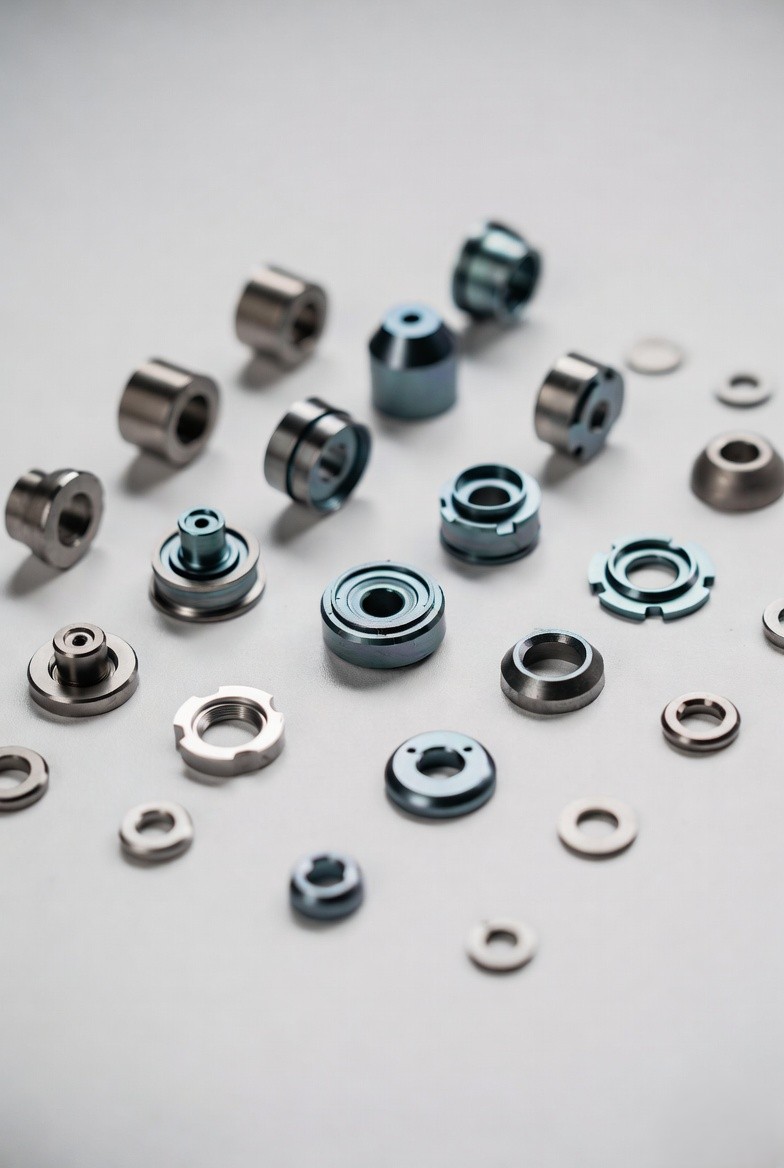
The Invisible Components Powering Modern MedicineA Story by Pujitha Reddy The global medical precision parts market grows to $22.42B by 2030. Explore how minimally invasive surgery, wearable devices, lab automation, and advanced surface engineering are driving this high-pre Small Parts, Enormous StakesThe titanium screw securing a spinal implant must hold its position for decades inside a living body. The micro-valve controlling fluid flow in a genomic sequencing machine must repeat the same action millions of times without deviation. The biocompatible polymer housing of an implantable cardiac sensor must survive indefinitely in an environment more hostile than almost any industrial setting. Medical precision parts are the components that make modern healthcare possible, and their demands on manufacturing are extraordinary. The global medical precision parts market, valued at $16.00 billion in 2024, is projected to reach $22.42 billion by 2030, growing at a CAGR of 5.78%. This growth reflects expanding medical device complexity, rising surgical volumes, the proliferation of wearable and implantable technologies, and the rapid automation of laboratory and diagnostic workflows. Know More : https://www.arizton.com/market-reports/medical-precision-parts-market Minimally Invasive Surgery: Driving Extreme Precision RequirementsOne of the most powerful demand drivers in the medical precision parts market is the global shift toward minimally invasive surgical procedures. Compared to open surgery, minimally invasive approaches require instruments and implants that are far smaller, often operating through incisions of just a few millimeters, while maintaining the structural integrity and functional precision required for reliable clinical performance. Nitinol stents, titanium micro-surgical tools, and tiny endoscopic instrument components all depend on manufacturing tolerances measured in microns rather than millimeters. A dimensional error that would be acceptable in a conventional engineering context is not acceptable in a device that will navigate a coronary artery or stabilize a fractured vertebra. This reality makes CNC machining the dominant manufacturing process in the market, accounting for approximately 28% of total revenue. CNC machining's ability to deliver micron-level tolerances across complex geometries in materials including stainless steel, titanium, high-performance polymers, and cobalt-chrome alloys makes it indispensable for the production of surgical instruments, orthopedic implants, and diagnostic device housings where other manufacturing methods cannot reliably achieve the required precision. Wearable and Implantable Devices: Pushing Miniaturization ForwardThe rapid growth of wearable health monitors and implantable medical devices is creating sustained demand for ultra-miniaturized, biocompatible components. Continuous glucose monitors from companies like Dexcom require micro-sensors capable of operating continuously in the body's interstitial fluid with sufficient accuracy to guide insulin dosing. Implantable cardiac sensors from Medtronic must function reliably for years in a physiologically demanding environment while maintaining connectivity with external monitoring systems. These applications push manufacturers toward ultra-fine tolerances, advanced biocompatible materials, and component geometries that would have been considered impossible to manufacture reliably just a decade ago. Metals, particularly titanium, stainless steel, and cobalt-chrome alloys, dominate the materials segment with the largest share and the fastest growth at a CAGR of 6.12%, reflecting their unique combination of strength, corrosion resistance, long-term stability, and proven biocompatibility. Lab Automation: Precision Fluidics at ScaleA less visible but equally significant growth driver in the medical precision parts market is the rapid expansion of laboratory and biotechnology automation. Modern automated systems for genomic sequencing, drug discovery, clinical diagnostics, and pharmaceutical manufacturing depend on micro-level precision in fluid handling, requiring micro-valves, pipetting heads, flow regulators, and cartridges that can process extremely small liquid volumes with absolute repeatability. Illumina's NovaSeq 6000 sequencing platform depends on precision fluidic components to process large-scale genomic data reliably. Hamilton's Microlab STAR liquid handler uses ultra-precise pipetting technology to reduce human error in drug discovery and diagnostic workflows. Thermo Fisher's AI-integrated liquid handling systems use smart calibration to minimize downtime and maintain reliability in high-throughput clinical laboratory environments. The integration of AI into laboratory automation is amplifying the precision requirements for fluidic components rather than reducing them. When an automated system is performing thousands of operations per run, the mechanical components it depends on must perform consistently at the start of run one and at the end of run ten thousand. Surface Engineering: Making Parts Smarter and SaferAdvanced surface engineering is emerging as one of the most commercially significant trends in medical precision parts manufacturing. The application of nano-texturing, specialized coatings, and chemical surface treatments is extending the performance envelope of precision components beyond what their base materials alone could achieve. Medtronic's titanium cardiac implants use nano-textured surfaces that encourage osseointegration, reducing rejection risk and extending implant service life. Anti-fouling coatings on micro-nozzles used in diagnostic equipment prevent protein and bacterial buildup that would otherwise compromise test accuracy and require frequent maintenance. Treated PEEK polymer components in drug delivery cartridges from Phillips-Medisize withstand aggressive sterilization protocols while maintaining dimensional integrity across multiple use cycles. These advances are not incremental improvements to existing products. They are enabling new applications that would not be possible without them, expanding the addressable market for precision parts into device categories and clinical settings that previously could not justify their use. Orthopedics: The Largest Application SegmentOrthopedic implants represent the largest single application for medical precision parts, driven by aging global populations, rising rates of osteoarthritis, and growing demand for joint replacement and spinal stabilization procedures. Hip and knee replacements, spinal fusion systems, and trauma fixation devices all require precision-manufactured metal components that meet exact dimensional specifications to achieve reliable fit and long-term performance in vivo. The shift toward patient-specific implants, enabled by advanced CNC machining and the additive manufacturing capabilities that Linamar International unveiled in July 2025, is further expanding the precision requirements of this segment. When an implant is designed for a specific patient's anatomy rather than a population average, the manufacturing tolerance requirements become even more demanding, and the clinical outcomes justify the additional cost and complexity. Regional DynamicsNorth America leads the global medical precision parts market, supported by the concentration of major medical device manufacturers including Medtronic, Johnson and Johnson, and Stryker, the stringent FDA and ISO regulatory environment that drives quality investment, and high adoption of advanced surgical and diagnostic technologies. Asia-Pacific is the most dynamic growth region, with China, Japan, South Korea, India, and Singapore all investing heavily in healthcare infrastructure modernization, robotic surgical system adoption, and automated diagnostic capabilities. Seoul's Samsung Medical Center's 2025 integration of robotic surgical arms requiring micron-tolerance components illustrates the practical dimension of this demand. The Regulatory and Quality ImperativeThe medical precision parts market operates under a level of regulatory scrutiny that few other manufacturing sectors face. ISO 13485, FDA Quality System Regulation, and CE marking requirements create comprehensive frameworks for design control, process validation, material traceability, and post-market surveillance that apply to every component supplied into a medical device. For manufacturers, compliance with these standards is not optional and not inexpensive. GEMSONS' September 2024 upgrade to cleanroom-enabled CNC machining infrastructure with expanded micro-machining capability reflects the continuous investment required to maintain and extend regulatory compliance while meeting the evolving technical demands of medical device customers. © 2026 Pujitha Reddy |
Stats
11 Views
Added on April 6, 2026 Last Updated on April 6, 2026 |

 Share This
 Email
Email Facebook
 Twitter
 Read Request
 My Library
 Subscribe
 Flag Writing