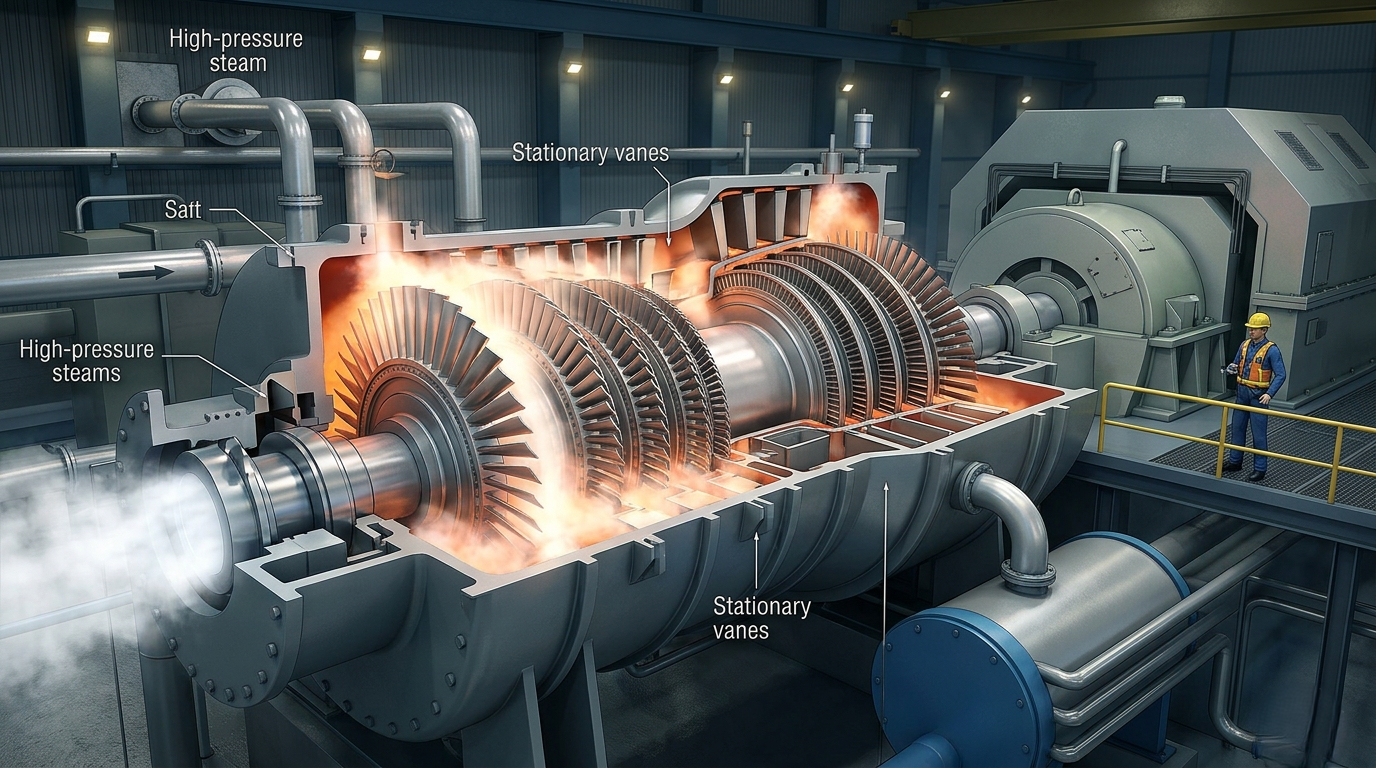
Steam Turbines in a Changing Energy World: Efficiency, Decarbonization, and Digital InnovationA Story by Pujitha Reddy The global steam turbine market grows to $23.48B by 2030. Explore how combined-cycle plants, cogeneration, AI-driven maintenance, additive manufacturing, and nuclear SMRs are reshaping this essential An Essential Technology Adapting to New DemandsSteam turbines have been converting heat into electricity for more than a century. They power utility grids, industrial facilities, district heating networks, marine vessels, and desalination plants across every region of the world. Despite the rise of solar panels and wind turbines, steam turbines remain indispensable: they are the primary conversion technology in coal, gas, nuclear, biomass, geothermal, and concentrating solar power plants, and they are not going away. They are, however, evolving at a pace that is transforming both their performance and their commercial relevance. The global steam turbine market, valued at $19.50 billion in 2024, is projected to reach $23.48 billion by 2030, growing at a CAGR of 3.15%. This measured growth reflects a sector that is simultaneously managing the decline of coal-fired generation, the expansion of combined-cycle and cogeneration applications, the modernization of aging infrastructure, and the integration of digital technologies that are meaningfully improving performance and reducing downtime. Know More : https://www.arizton.com/market-reports/stream-turbine-market The Technology Driving Performance GainsRecent advances in materials science, manufacturing technology, and digital engineering are enabling performance improvements that would not have been achievable a decade ago. Advanced high-temperature alloys, corrosion-resistant coatings, and lightweight composite components are extending turbine service life, reducing maintenance requirements, and enabling operation at higher temperatures and pressures that improve thermodynamic efficiency. Supercritical and ultra-supercritical steam cycles, which operate at extreme conditions to squeeze more electricity from each unit of fuel, are becoming standard specifications for new large-scale thermal plants. Additive manufacturing is changing how complex turbine components are produced. Three-dimensional printing and investment casting now allow the fabrication of intricate blade geometries with optimized cooling pathways and minimal manufacturing defects. Siemens' adoption of additive manufacturing for turbine blade tips improved component strength by 15% while cutting prototyping timelines by 30%. Digital twin technology and AI-driven simulation are enabling operators to model turbine behavior under varying operating conditions before making physical changes, reducing the trial-and-error costs associated with performance optimization. IoT-connected sensors feeding real-time operating data into predictive maintenance algorithms are reducing unplanned downtime and enabling condition-based maintenance schedules that cut lifecycle costs meaningfully. Combined Cycle and Cogeneration: The Growth SegmentsAmong the technology sub-segments within the steam turbine market, cogeneration cycle technology is recording the fastest growth at a CAGR of 3.89%. Combined heat and power plants, which simultaneously generate electricity and capture usable thermal energy from the same fuel input, achieve thermal efficiencies that conventional power plants cannot match. The ability to pair gas turbines and steam turbines in combined-cycle configurations has made this approach the dominant choice for new gas-fired power capacity in developed markets. The shift from coal to gas in North America and Europe is accelerating the deployment of combined-cycle plants that require both gas turbines and steam turbines as their primary power generation equipment. Siemens Energy's 2025 contract worth $1.6 billion to deliver steam turbines and gas turbines for two combined-cycle power plants in Saudi Arabia, designed to add approximately 1.8 gigawatts of low-carbon electricity while integrating carbon capture capability, illustrates the scale and ambition of this trend at its most advanced. Gas-fired steam turbines represent the fastest-growing fuel type sub-segment with a projected CAGR of 3.59%, reflecting the industry-wide transition from coal and oil-fired generation toward cleaner combustion combined-cycle systems. Nuclear and Small Modular Reactors: A New OpportunityOne of the most commercially significant new opportunities emerging for steam turbine manufacturers is the growth of small modular reactor technology. Nuclear power's zero-carbon electricity generation profile makes it strategically attractive for countries seeking to decarbonize their power sectors while maintaining the baseload reliability that intermittent renewables cannot provide. Siemens Energy's 2025 exclusive partnership with Rolls-Royce Small Modular Reactors, establishing Siemens Energy as the supplier of steam turbines, generators, and auxiliary systems for Rolls-Royce SMR plants generating 470 megawatts each, is a landmark commitment that positions steam turbine manufacturers at the heart of the nuclear renaissance. As SMR technology progresses from demonstration to commercial deployment, the demand for purpose-built steam turbines optimized for smaller, modular reactor designs will grow significantly. Retrofitting: The Mature Market OpportunityIn North America and Europe, where greenfield thermal plant development is limited by decarbonization policy and competitive renewable economics, the retrofit and life extension market is one of the primary sources of revenue growth for steam turbine manufacturers and service providers. Modernizing aging power plants with advanced blade profiles, improved sealing systems, and digital control upgrades can deliver efficiency improvements of 2 to 3% from existing assets while extending operational life by decades. This represents an attractive return on investment for plant operators who face the alternative of replacing fully depreciated assets with expensive new construction. Mitsubishi Power, Doosan Enerbility, and Ansaldo Energia have developed modular upgrade kits and predictive maintenance bundles that reduce delivery times by 20 to 30% compared to conventional retrofit approaches, while improving turbine availability throughout the refurbishment period. The development of standardized retrofit solutions has become an essential strategic element for OEMs operating in markets with constrained greenfield development pipelines. Asia-Pacific Leads, Middle East EmergesAsia-Pacific dominates the global steam turbine market with over 46% share, driven by China's ongoing development of coal, gas, and biomass-fired power capacity and India's large-scale thermal infrastructure investment. Industrial parks and special economic zones across India, China, and Vietnam require high-capacity, reliable power solutions for energy-intensive sectors including metals, chemicals, and refining. Triveni Turbines in India supplies engineered steam turbine solutions up to 100 megawatts and is a direct beneficiary of the government's Make in India initiative, which encourages domestic manufacturing of power generation equipment. The Middle East and Africa is an emerging hotspot, driven by large desalination plant deployments and upstream oil and gas development. Saudi Arabia and the UAE are making state-backed investments in reliable steam-cycle capacity, with Siemens Energy, GE, and Mitsubishi Hitachi Power Systems all active in delivering advanced turbine technology for the region's power plant projects. Europe holds approximately 16.7% market share, with activity focused primarily on cogeneration, biomass retrofits, and life-extension upgrades rather than large greenfield thermal installations. North America benefits from fleet modernizations, combined-cycle gas turbine deployments, and government programs including U.S. Department of Energy CHP partnerships and Canada's Clean Electricity Regulations. Trade Tensions Adding Cost PressureThe ongoing U.S.-China trade dispute is adding cost complexity to the global steam turbine market. Duties of 25% on steel and aluminum have increased the cost of turbine casings, rotors, and auxiliary components, squeezing manufacturer margins. Nickel and chromium alloy prices remain elevated due to indirect tariff risk. A 90-day tariff relief agreement reached in May 2025, reducing U.S. tariffs on Chinese goods from 145% to 30% and Chinese tariffs on U.S. goods from 125% to 10%, provides temporary relief, but uncertainty persists about what happens when the relief period expires. Manufacturers are responding by diversifying supply chains, increasing domestic sourcing where feasible, and exploring alternative alloy specifications that reduce exposure to affected materials. The Competitive LandscapeSiemens Energy, GE Vernova, Mitsubishi Power, Toshiba, and Doosan Skoda Power collectively account for approximately 60 to 65% of global turbine sales and service contracts. These manufacturers compete on technological capability, global service network depth, digitalization offerings, and the ability to deliver complex multi-equipment contracts for large combined-cycle and nuclear projects. Regional specialists like Triveni Turbines serve the smaller turbine segment in emerging markets, offering engineered solutions tailored to local conditions and benefiting from proximity advantages in delivery and service. © 2026 Pujitha Reddy |
Stats
5 Views
Added on April 7, 2026 Last Updated on April 7, 2026 |

 Share This
 Email
Email Facebook
 Twitter
 Read Request
 My Library
 Subscribe
 Flag Writing