
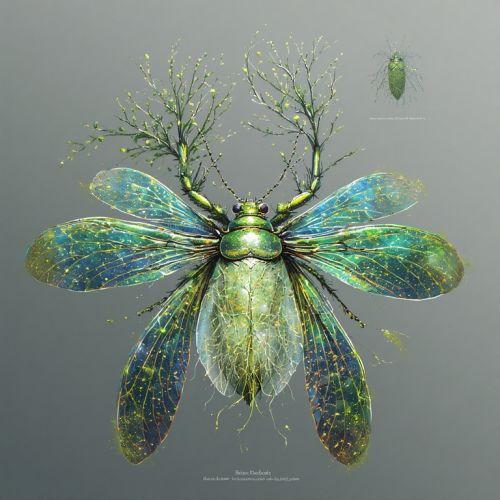
Ecological Appendix I - Northern ForestsA Chapter by HaleyBMossbeetle (Carapax muscivorus)
Size & Build: About 5 cm long, compact with six articulated legs ending in fine, hooked tarsi for gripping moss and uneven terrain. Body slightly flattened dorsoventrally, allowing it to navigate dense moss mats and shallow water pools with ease. Carapace & Underbelly: Iridescent green shell patterned like moss fronds, giving camouflage among moss carpets. Underbelly lined with fine, root-like filaments capable of absorbing excess water and nutrients directly from saturated substrates. Wings are translucent, folding neatly beneath the carapace when not in use; flight is short, mostly for repositioning within moss beds. Habitat: Moist terraces, root-pools, and shaded moss beds. Particularly sensitive to environmental anomalies like the Rogue Bloom, avoiding zones of spread, suggesting biochemical incompatibility. Behavior & Ecology: Primarily active after rainfall. Burrows aerate oversaturated soil, while bioluminescent signaling allows coordination in low-light conditions. Swarms function as a bio-indicator for soil oxygen levels, dispersing spores and preventing moss mats from becoming stagnant. Cultural Significance: Canopy Wardens monitor their activity to detect ecosystem imbalance. Festivals incorporate carved wooden Mossbeetle effigies released into rivers to symbolize cleansing and renewal.
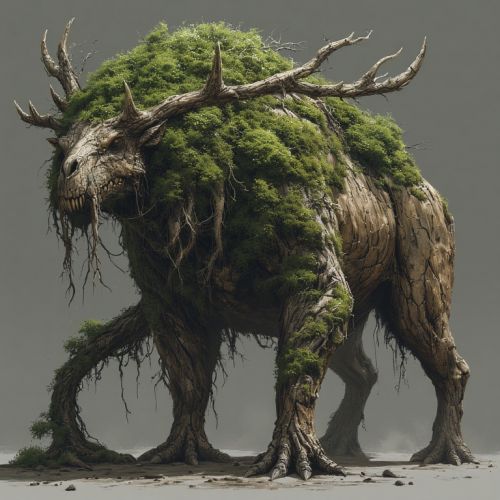
- Rootbound Beast (Ungulatus radicis)
Size & Build: A massive herbivore averaging 2.3 m at the shoulder. Limbs thick but flexible; shoulders sloped to accommodate heavy antler-root structures. Hooves split into three prongs with textured pads for gripping vine-lattices and uneven forest floors. Hide & Camouflage: Bark-textured skin with natural striations mimicking tree grain. Color ranges from deep umber to mossy olive, with seasonal changes as antler moss adjusts to sunlight absorption. Thick hide resists abrasions from roots and thorny vegetation. Antlers & Symbiosis: Skull bears antler-like root extensions, heavily covered in fine symbiotic moss. Moss stores sunlight, providing slow nutrient release during lean months. Antler growth rings correspond to seasonal energy fluxes; shed naturally every few years. Head & Feeding: Broad, flat muzzle with strong incisors for stripping vine fruits and root crowns. Eyes set laterally for wide panoramic vision; ears small but sensitive to movement, able to detect approaching predators or disturbances along migration corridors.
Behavior: Migratory herds of 10-30 individuals follow glowing rivers and seasonal fruiting trees. Grazing is methodical; moss on antlers acts as a portable solar-powered snack for lean months. Gentle unless paths are blocked, stampedes are rare but devastating. Ecological Role: Acts as forest gardener, dispersing seeds, aerating soil with hooves, and maintaining vine-moss equilibrium. Herd movements dictate growth patterns for moss beds, fruiting trees, and energy corridors. Cultural Significance: Wardens avoid redirecting herds, believing interference brings famine. Naturally shed antlers are carved into bone-horn flutes used in canopy rituals. Feeding on Bloom tendrils is toxic; even accidental ingestion causes seizures, marking areas to avoid.
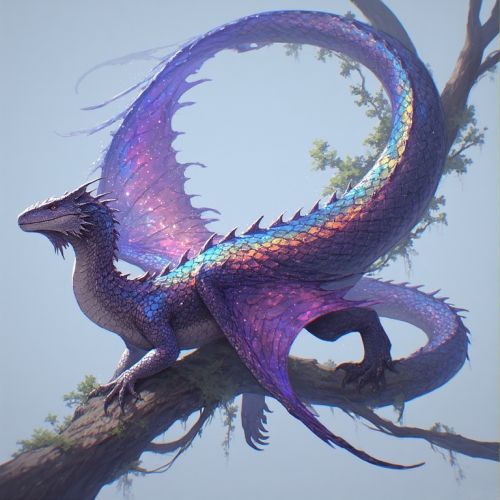
- Canopy Serpent (Serpentis aetherialis)
Size & Build: Adult length ranges 8-12 m, sinuous and muscular but not bulky. Ribs extended into flexible gliding fins that allow slow, controlled descents between canopy layers. Tail long and tapered for balance in wind corridors. Scales & Camouflage: Iridescent scales refract twin-sunlight, creating constantly shifting rainbow patterns across its body. Patterns shift dynamically depending on light angle and background foliage, giving near-perfect visual concealment in the canopy. Head & Senses: Broad, triangular head with slit pupils capable of detecting movement and heat across several meters. Nostrils and sensory pits along the jaw allow detection of subtle air currents, helping it track gliders or small mammals in motion. Habitat & Nesting: High-canopy nests constructed from tightly woven leaf bundles reinforced with crystal shards. Typically positioned along strong wind corridors to optimize ambush opportunities and gliding descents. Behavior & Diet: Ambush predator, feeding on Skyweaver's, juvenile ungulates, and occasional gliders. Sheds large coils of skin twice yearly; old scales are collected for durable weaving or ritual use. Juveniles are unusually curious, often trailing gliders or explorers for observation. Ecological Role: Apex arboreal predator, helping maintain canopy population balance and indirectly influencing migration and nesting patterns of smaller species. Cultural Significance: Wardens treat them as “sky-wardens,” symbols of patience and vigilance. Songs describe them as “bridges alive,” representing connection and stillness. Shed scales are used in wards for protection or ritual attire, symbolizing silent strength.
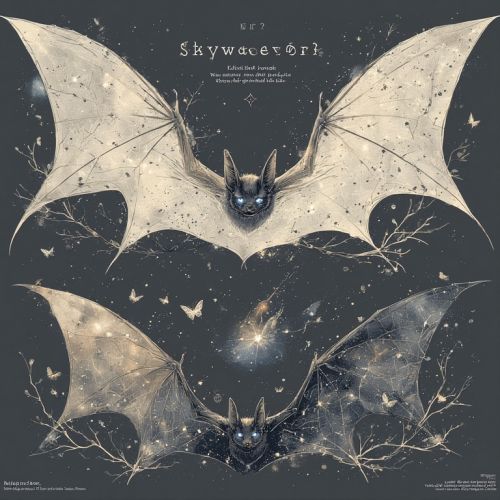
- Skyweaver (Chiroptera lucens)
Size & Build: Wingspan ~1.2 m, body streamlined for agile nocturnal flight. Membranes are thin but reinforced with microscopic crystalline threads along wing bones and across joints, creating both structural strength and the refractive starlight effect. Wings & Coloration: Wing membranes are semi-translucent, patterned with naturally woven crystalline threads that refract ambient light. Trails of refracted light give the appearance of woven starlight when in flight. Faint blue glow from eyes provides limited self-illumination for navigation without alarming prey. Head & Senses: Elongated muzzle for nectar feeding and insect capture. Echolocation finely tuned for canopy topography. Eyes adapted to low-light vision; irises faintly phosphorescent to help colonies maintain cohesion in darkness.
Behavior: Nocturnal pollinator and insectivore. Colonies of 40-80 individuals roost in hollowed canopy crystals, emerging at night in synchronized arcs. Wing filaments are shed seasonally, harvested for tensile fibers used in ceremonial construction or artisan crafts. Cultural Significance: Serve as guides for night travel; glider pilots follow their illuminated flight paths. Harvested wing filaments used in ceremonial lanterns and woven decorations during the Skybound Festival.
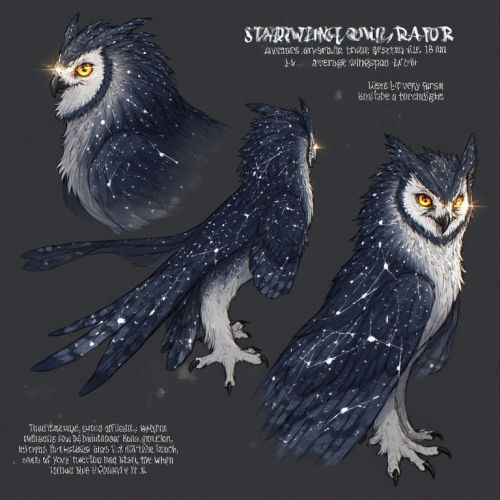
- Starwing (Strigidae stellaris)
Size & Build: Wingspan ~1.8 m. Broad-chested, powerful wings designed for gliding along wind corridors and precise maneuvering in canopy spaces. Talons strong but elongated for gripping branches, rocky outcrops, and small prey. Plumage & Camouflage: Silver-white streaks across deep charcoal feathers form patterns reminiscent of constellations. The streaking creates natural disruption camouflage during low-light hunting. Head and back have slightly denser plumage for stealth and insulation. Eyes & Vision: Eyeshine produces golden flare under torchlight or twin-sun twilight. Acute low-light vision combined with sensitive motion detection makes them effective twilight hunters.
Behavior & Hunting: Solitary hunters, primarily active during twilight and pre-dawn. Diet includes Skyweaver's, rodents, and small fish from canopy pools. Capable of memorizing wind corridor paths and returning to the same hunting zones across generations. Habitat & Nesting: Nests placed on high ridges, cliff edges, or canopy gaps along consistent wind corridors. Nesting sites reused and expanded across generations, creating long-term “family mapping” of hunting territory. Cultural Significance: Seen as keepers of ancestral memory. Feathers used in funerary rites to guide souls. Presence on bridges or terraces considered a protective omen for travelers. Ecological Role: Apex aerial predator in canopy ecosystems. Regulates prey populations, influencing migration and activity patterns of Skyweaver's and small rodents.
- Glowfern (Luminifolia sylvaris)
Size & Structure: Fronds range 0.5-1.2 m in height, with pinnate leaves that taper into delicate points. Stems are sturdy yet flexible, allowing them to sway with wind and support clustered fronds without toppling. Bioluminescence: Symbiotic photosynthetic algae embedded in fronds produce soft blue-white light. Intensity follows a circadian rhythm tuned to twin suns: strongest during low-light hours, faint during peak daylight. Light guides nocturnal pollinators and signals local energy flux in terraces. Roots & Soil Interaction: Shallow but widespread root network secretes mild nutrients, fertilizing surrounding plants and stabilizing terrace soil. Roots adapt to terraced architecture, expanding along ledges while avoiding dense moss beds. Behavior & Growth: Fronds respond to local light and energy conditions. Overgrowth can occur if energy flux is unusually high, leading to thick clusters that can overshadow other flora, a situation exacerbated by Rogue Bloom interference. Gentle manual pruning or ritual singing encourages fronds to grow in desired patterns. Ecological Role: Provides illumination and navigation cues for small pollinators, insects, and nocturnal animals. Nutrient secretion aids moss and low-lying plants. Acts as a living signal for Stewards monitoring terrace health.
Cultural Significance: Central to festival lighting and ritual groves. Used in medicinal preparations and ecological ceremonies. Residents sing to Glowferns, directing growth to sculpt terraces or light paths.
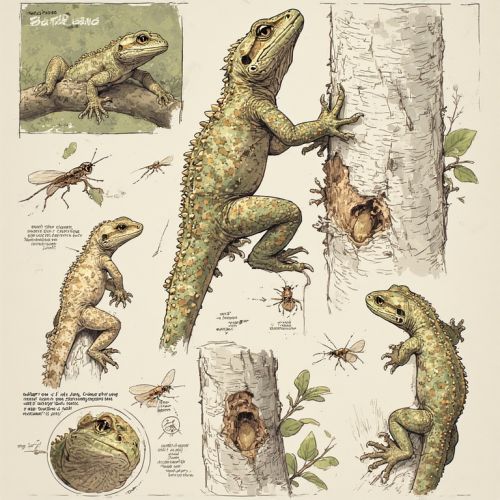
- Barkback (Camouflagea arboris)
Size & Build: 30-50 cm in length, slender with a flattened body to cling closely to tree trunks and branches. Limbs are well-muscled for vertical climbing, ending in sharp, curved claws. Tail prehensile enough to stabilize on thin canopy platforms. Skin & Camouflage: Rough, bark-textured skin with subtle ridges and fissures. Capable of limited color shifts, mottled gray, brown, or mossy green, to match immediate surroundings. Texture breaks up silhouette, making it nearly invisible when stationary. Head & Feeding: Short, triangular head with quick, flicking tongue for snatching small insects. Eyes positioned for good lateral and forward vision, enabling detection of predators and prey across branches. Habitat: Tree trunks, canopy branches, and platforms within the Canopy Metropolis. Prefers areas with moderate sunlight and nearby moisture to sustain insect prey. Behavior: Diurnal, moving slowly along trunks and canopy platforms. Feeds on insect pests that threaten Glowferns and moss beds, acting as a natural “garden assistant.” Uses color-shifting camouflage to evade predators or surprise prey. Cultural Significance: Observed during canopy festivals and daily stewardship patrols. Considered a helpful companion by Stewards, earning it the nickname “garden assistant.” Ecological Role: Controls insect populations, indirectly maintaining moss terraces and Glowfern health. Camouflage allows coexistence with larger arboreal predators.
© 2025 HaleyB |
Stats
184 Views
Added on August 19, 2025 Last Updated on August 29, 2025 |

 prev chapter

 Share This
 Email
Email Facebook
 Twitter
 Read Request
 My Library
 Subscribe
 Flag Writing