
Ecological Appendix II - Central HighlandsA Chapter by HaleyBSolarvine (Vitis solaria)Classification: Sun-harvesting climbing plant. Morphology: Robust vine with broad, translucent leaves interlaced with crystalline filaments that act as photosynthetic prisms. Each leaf adjusts its angle throughout the day to follow the path of the twin suns. Mature tendrils develop mineralized hooks to secure themselves to quartz outcrops, terrace walls, or urban spire structures. Habitat: Prefers high-exposure regions, mountain slopes, highland terraces, and Crystalspire peripheries, where twin-sunlight is most abundant. Thrives particularly on quartz-rich surfaces where resonance and light converge. Behavior & Ecology: Absorbs and stores solar energy during the day; releases it as faint warmth and low-level illumination through its leaf-crystals at night. Root systems enrich soil by excreting trace minerals, fostering companion plant growth. Pollinated by Lumin's and certain canopy-dwelling beetles. Cultural Significance: Forms the living backbone of many highland energy networks, powering lanterns, heating arrays, and ceremonial glow-paths during festivals. Pruned shoots are woven into ritual braids during the Solar Concord rites, symbolizing continuity and shared vitality. Interactions: Heavily cultivated but strictly monitored, overharvesting or improper pruning can disrupt its energy release cycle. Notes: Prolonged exposure to Bloom energy can cause uncontrolled vine proliferation, sometimes engulfing entire terraces. Sages deploy harmonic pruning techniques to prevent runaway growth near resonance zones.
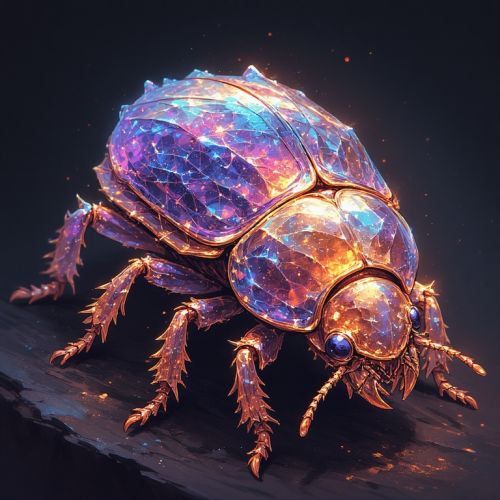
- Lumicrystal Beetle (Chrysocorona lumina)
Classification: Bioluminescent energy-harvesting insect; average size 3-4 cm. Morphology: Possesses a rigid crystalline carapace that refracts ambient light into shifting prismatic hues. Segmented abdomen contains specialized energy-storage organs that glow faintly when fully charged. Antennae tipped with micro-crystals act as both sensory organs and resonance receivers. Habitat: Found clustering around Solarvine growths, reflective quartz outcrops, and the foundations of Crystalspires. Most active during dusk and early night when residual sunlight lingers. Behavior & Ecology: Feeds primarily on Solarvine sap and microalgal films, converting stored energy into a dim bioluminescent pulse. Plays a key role in pollen propagation by carrying spores and pollens along their walking trails. During overcast periods, they become sluggish and retreat to mineral-rich crevices to conserve energy. Cultural Significance: Highly regarded as harbingers of growth cycles; their energy pulse patterns are observed by Sages to time agricultural resonance and terrace planting. Crystalline shells are collected after natural molting and used in ceremonial jewelry, festival streamers, and light prisms. Interactions: Their feeding supports Solarvine health when populations are balanced, but swarming can drain vines prematurely. Natural predators include Barkback's and certain canopy birds. Notes: Areas affected by Bloom interference show diminished beetle glow and erratic navigation, leading to disrupted pollination and weakened energy transfer across terrace ecosystems.
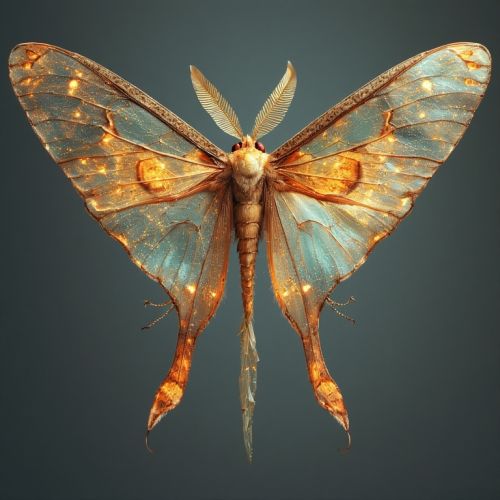
- Crystalwing (Noctua crystallis)
Classification: Nocturnal pollinating insect; wingspan ~15 cm. Morphology: Features delicate, transparent wings threaded with crystalline veins that refract starlight and residual solar glow. Luminescent markings along the wing edges serve dual purposes: attracting mates and startling potential predators. Antennae tipped with light-sensitive nodules help navigate complex air currents between terraces. Habitat: Roosts within quartz alcoves, Solarvine canopies, and crystal terrace eaves where ambient resonance stabilizes their wing structure. Often seen swarming around highland lanterns and spire crowns. Behavior & Ecology: Active shortly after dusk, Crystalwings pollinate high-altitude and cliffside blooms that rely on night breezes for pollen transfer. Larvae consume leaf-crystals, contributing to controlled Solarvine pruning and preventing overgrowth. Adults exhibit synchronized aerial dances during mating cycles, creating faint glimmering trails visible from the canopy floor. Cultural Significance: Revered as “Lantern Spirits” during seasonal festivals; trained Sages release them to illuminate processions or mark the start of resonance ceremonies. Their flight patterns are meticulously documented to study energy distribution and crystal pulse flow across spires. Interactions: Predated upon by Barkback's and Lumin's during food scarcity. Populations fluctuate with Solarvine density and seasonal crystal resonance peaks. Notes: Highly sensitive to harmonic disruptions, excessive bridge vibration or spire resonance can force colonies to relocate, often leaving entire terraces without pollination services until they return.
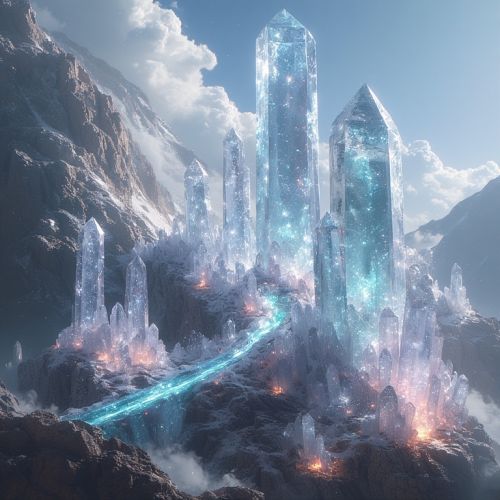
- Crystal Conduits (Conductus aurum)
Classification: Semi-natural and engineered mineral channels designed for energy conduction and distribution. Morphology: Primarily composed of quartz lattices and high-purity crystalline veins. Many are natural formations later refined into structured conduits, carved with resonance grooves and etched with harmonic runes. When active, they emit a soft luminescence that pulses in sync with energy flow intensity. Habitat: Found within Crystalspire cities, highland terraces, and beneath Solarvine arrays. Often follow natural fault lines and quartz seams. Behavior & Function: Channel and stabilize solar-derived and resonance-based energies between spires, terraces, and ritual sites. Vibrational feedback serves as an early warning for saturation or fracture risk. In rare cases, can self-heal minor fractures through slow crystal regrowth when aligned with Solarvine root systems. Cultural Significance: Integral to urban infrastructure, powering agricultural terraces, crystal-based technology, and ceremonial energy displays. During seasonal festivals, conduits are overlaid with luminescent vines to create living light pathways. Interactions: Can influence local ecosystems by creating heat gradients or resonance fields that attract luminescent insects (e.g., Lumicrystal) and pollinators (e.g., Crystalwings). Improper alignment has been linked to migration disruption in Quartz-Spined Leapers and erratic Bloom growth. Notes: Overloading the network can cause cascading fractures, releasing harmful resonance bursts. Sages maintain strict flow regulations and conduct regular harmonics testing to prevent destabilization.
- Solar Plateau Winds (Aero sylvarum)
Classification: Persistent high-altitude wind system; classified as a dynamic ecological phenomenon rather than a living entity. Morphology: Characterized by stable yet seasonally shifting currents that sweep across highland plateaus and floating platforms. Directional flow is tracked by suspended pollen, aerial spores, and gliding insect patterns. Habitat: Found along Solarvine terraces, floating transport corridors, and highland migration routes. Intensifies around Crystalspire elevations and cliffside channels. Behavior & Function: Facilitates seed dispersal for Solarvine and other sun-dependent flora. Assists in glider-based transport and migration of highland fauna. Drives wind-sensitive energy devices and resonance turbines. Currents often shift subtly before seasonal changes, acting as natural barometers.
Cultural Significance: Integral to plateau life, used to plan agricultural cycles, glider routes, and ceremonial events. Wind-shift readings are part of weekly observations by Sages and glider wardens. Notes: Bloom crystal proliferation can create localized turbulence, weakening or redirecting natural corridors. Prolonged disruption has been linked to delayed Solarvine germination and altered gliding patterns in Quartz-Spined Leapers.
© 2025 HaleyB |
Stats
206 Views
Added on August 20, 2025 Last Updated on August 29, 2025 |


 prev chapter

 Share This
 Email
Email Facebook
 Twitter
 Read Request
 My Library
 Subscribe
 Flag Writing