
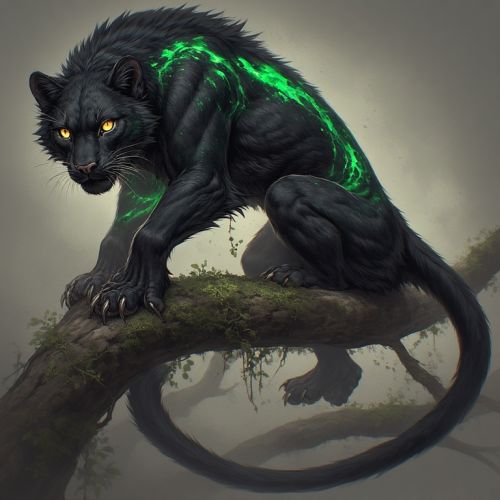
Ecological Appendix II - Northern ForestsA Chapter by HaleyBShadowfang (Panthera umbrae)Size & Build: Large, muscular feline built for stealth and agility in the upper canopy. Body length 1.8-2.2 m, tail long and flexible for balance across branches. Limbs are lean but strong, capable of gliding between branches in short leaps. Fur & Markings: Jet-black fur with faint reflective streaks along flanks and shoulders. These subtle markings catch dim canopy light, breaking up its outline for near-invisibility at night. Fur is short but dense, reducing noise during movement. Claws & Senses: Retractable claws sharp and curved for gripping branches silently. Highly sensitive whiskers detect branch vibrations; acute low-light vision allows hunting during twilight and night. Habitat: Upper canopy layers and dense glades of the Northern Forest. Prefers shadowed regions with complex branch networks. Behavior & Hunting: Nocturnal apex predator. Hunts Glade Striders and smaller arboreal fauna, stalking silently through shadowed glades and canopy layers. Moves methodically, often using elevated vantage points for ambush. Cultural Significance: Feared yet protected by Canopy Wardens. Sightings logged carefully; shifts in movement patterns serve as ecological indicators, including Bloom spread or herbivore scarcity. Ecological Role: Maintains herbivore populations, influencing migration and grazing patterns. Population density correlates with forest health; their presence signals a balanced ecosystem.
- Glade Striders (Velocis sylvarum)
Size & Build: Tall, quadrupedal grazers averaging 2.5 m at the shoulder. Slender but muscular limbs support long, graceful necks for browsing moss plains and terrace flora. Hooves broad with slight webbing to distribute weight over soft moss beds. Fur & Markings: Leaf-patterned hide that shifts with seasonal light and vegetation, spring green, summer bronze, autumn amber. Nighttime antler-like crests glow faintly, faint luminescence acting as guides for the herd and deterrence against predators. Fur captures bioluminescent spores, dispersing them across migration routes. Behavior: Highly social and migratory. Move along moss plains and highland terraces in coordinated herds. Grazing prevents moss overgrowth and maintains soil and terrace balance. Crests also signal herd cohesion at night. Ecological Role: Keystone species. Shapes moss density, fertilizes soil, creates migration corridors for smaller fauna, and spreads forest seeds. Their movement patterns are critical for ecosystem health. Cultural Significance: Sages use herd behavior to mark seasonal cycles, effectively living calendars. Wardens recognize them as guardians of under-canopy balance and monitor herd movements to detect ecological shifts.
- Lumin (Noctiluca constellara)
Size & Build: Wingspan ~25 cm, slender body adapted for slow, hovering flight. Antennae long and feathered, highly sensitive to subtle energy and light resonance. Legs short, primarily for landing on flowers and crystal nodes. Wings & Coloration: Wings patterned like miniature starfields, tiny spots of reflective scales mimic constellations. Base coloration dark midnight blue or deep violet, making star-like specks stand out in dim light. Slightly translucent edges refract ambient energy from crystal nodes. Faint bioluminescence glows along wing veins, visible in darkness. Behavior: Nocturnal, drawn to crystal nodes and swarming over observatories at night. Erratic flight near Bloom crystals due to interference with natural light resonance. Hover over night-blooming plants to pollinate. Colonies often perform intricate aerial swirls around energy sources. Ecological Role: Key pollinators for night-blooming flora across moss plains and terraces. Their swarms influence local plant reproduction and guide apprentice Stewards in monitoring energy flow. Cultural Significance: Wing patterns recorded as omens; referred to as carriers of “echoes of the heavens.” Often incorporated into ceremonial artwork or ritual motifs.
© 2025 HaleyB |
Stats
209 Views
Added on August 21, 2025 Last Updated on August 29, 2025 |


 prev chapter

 Share This
 Email
Email Facebook
 Twitter
 Read Request
 My Library
 Subscribe
 Flag Writing