
Ecological Appendix II – Southern Plains: Lumina StewardsA Chapter by HaleyBSunveil Moss (Bryophyta solaria) Appearance & Structure: Forms low, dense carpets across plains, about 2-5 cm thick. Individual filaments are fine and golden, with a slight translucence that lets sunlight penetrate deep into the mat. Under the zenith of twin suns, filaments refract light to create a soft, shimmering halo effect across the moss carpet.Seasonal Dynamics: Expands vigorously during high-energy seasons, carpeting terraces and lowlands, then contracts in drier or low-energy periods, creating exposed patches of soil that guide grazer movement. Filament tips curl or fold subtly to regulate water retention and sunlight capture. Texture & Color: Golden base with pale amber tips. When dew collects, it sparkles faintly like dusted gems, drawing in small insects and herbivores. Color subtly shifts toward deeper amber or bronze in lower-energy seasons. Ecological Role: Foundation species for plains ecology. Supports invertebrate populations, provides primary nutrition for grazers, and regulates moisture and mineral cycling across terraces. Its seasonal cycles act as natural migration markers for herbivores like Prismhorns and Mossveil Hares. Cultural Significance: Lumina Stewards use it as a living calendar: the expansion and contraction of the mats signals planting cycles, festival timings, and migration tracking. 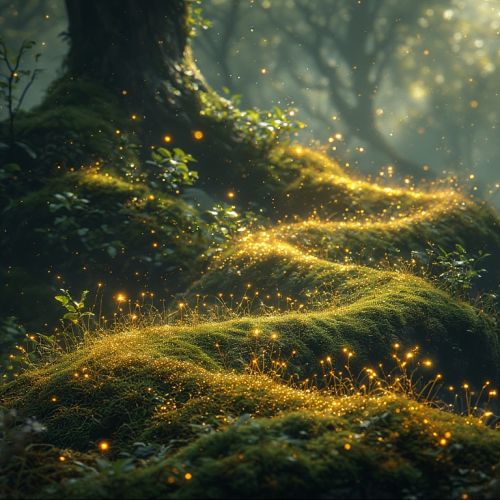 - Radiant Spires (Obelisia lucens) Color & Light Interaction: Base crystal is pale quartz with faint internal veins of gold or soft violet. Nodes catch ambient light and refract it, producing subtle halos even in low light. During seasonal energy surges, stalks vibrate minutely, and the hum resonates through the terraces, audible as a low, harmonic hum. Behavior: Prefer ley-line ridges where energy flux is high. Hum intensity increases with conduit activity, serving as a natural indicator for energy surges or instabilities. Nodes sway in resonance with wind, sometimes amplifying the hum in unexpected harmonics. Ecological Role: Act as anchor points for energy conduits, stabilizing the magical ecosystem. Their flowering nodes attract Lumin Moths and other pollinators adapted to energy-sensitive flora. Roots exude mineral-laden exudates that enhance surrounding soil and promote moss terrace growth. Cultural Significance: Harvesting is tightly regulated; removing a stalk improperly can collapse local energy channels, destabilizing both flora and fauna reliant on the terraces. Stewards use their resonance as a monitoring tool, changes in pitch or volume signal environmental shifts. 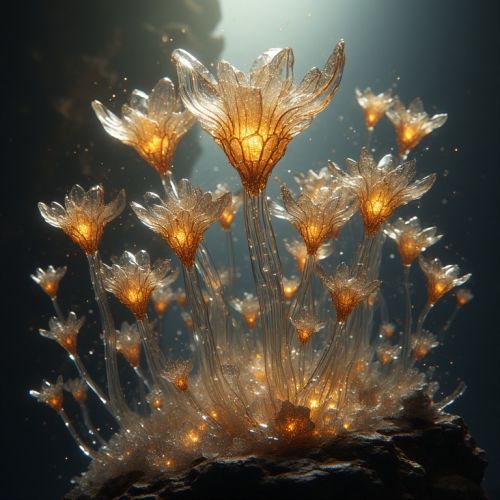 - Bloomridge Vines (Vitis aurorae) Flowers & Luminescence: Tiny bell-shaped flowers grow along the tendrils in clusters. Each bloom opens in near-perfect synchronization across the vine during equinox periods, releasing a faint, golden luminescence. At dusk, they emit shimmering spores that float like drifting embers, attracting insect and bird pollinators. Color & Texture: Stems are a muted reddish-brown with iridescent undertones; leaves are slender, elliptical, and deep green with faint veins that glow softly when energy surges pass through. The flowers are deep crimson fading to pale gold at the tips, giving the appearance of fire trails along the vine. Behavior & Growth: Slow but deliberate climbers, they anchor themselves in rocky or mossy terrain to stabilize slopes. Their coordinated flowering pulses are thought to align with energy surges, facilitating reproductive success in sync with environmental cycles. Ecological Role: Stabilize terraces and slopes against erosion. Nectar attracts migratory birds like Halo Swifts and Starback Cranes, forming an essential link in pollination networks. Their spores aid moss propagation by lightly fertilizing the ground and encouraging microflora growth. Cultural Significance: Frequently woven into Lumina festival tapestries, both for their visual beauty and symbolic representation of seasonal cycles. The spore glow inspires ceremonial lighting motifs in artwork and textiles.
- Glasswind Reeds (Phragmites vitrealis)
Size & Structure: Stalks reach 3-4 m in height, thin but strong, semi-transparent with faint internal striations that act like natural wind channels. Roots are dense and fibrous, anchoring floodplains and terraces while allowing flexibility in storms. Appearance & Texture: Stalks shimmer in sunlight, ranging from pale green to near-clear, with subtle opalescent highlights along the ridges. The nodes are slightly thickened, giving the stalks a segmented, flute-like look. Behavior: During high winds or storms, stalks bend gracefully rather than snapping, producing low, resonant whistles that can carry for hundreds of meters. These sounds serve as a natural warning system for nearby fauna and travelers. Ecological Role: Prevent soil erosion along riverbanks and terraces, stabilize highland floodplains, and provide habitat for small insects and amphibians. Their resonance and movement can alert migratory or grazing species to incoming storms. Cultural Significance: Harvested stalks are crafted into wind instruments, tuning devices, and resonant markers. Stewards often use them to track wind patterns or mark energy currents across plains terraces.
© 2025 HaleyB |
Stats
336 Views
Added on August 27, 2025 Last Updated on August 29, 2025 |


 prev chapter

 Share This
 Email
Email Facebook
 Twitter
 Read Request
 My Library
 Subscribe
 Flag Writing