
Ecological Appendix II - Western Floating Archipelago: Skyhaven ArtisansA Chapter by HaleyB Flora Auravine Lattice (Auravinea translucens) Size & Structure: Vining aerial plant with tendrils extending 2-5 m, forming intricate lattices beneath floating islands. Leaves are translucent, silver-green, and delicately veined, refracting sunlight into scattered beams that illuminate platform undersides. Leaves & Camouflage: Leaf surfaces adjust opacity according to sunlight intensity, maximizing photosynthesis while reducing water loss. Fine silvery hairs trap moisture and reflect ambient light, providing subtle concealment from herbivores. Growth & Symbiosis: Anchors in mineral-rich condensation along floating island undersides. Tendrils often host epiphytic microfauna, including small insects and mosses, creating miniature ecosystems. Roots secrete mild nutrient compounds that support adjacent flora. Behavior: Expands along undersides of islands, climbing and intertwining with native structures. Growth is slow but persistent, forming living platforms for small avians and arthropods. Seasonal flowering produces subtle bioluminescent spores that drift to nearby ecosystems. Ecological Role: Stabilizes island edges and soil structures, preventing erosion or collapse. Provides perches and nesting sites for small birds and microfauna. Tendrils act as conduits for water and nutrient flow, maintaining microhabitat health. Cultural Significance: Harvested sparingly for festival lighting, reflecting the lattice’s natural brilliance. Overharvesting can destabilize island edges, and communities enforce strict collection limits. Considered a symbol of balance between utility and ecological stewardship.  - Nimbus Fern (Folia nubivaga) Size & Structure: Epiphytic fern with fronds spanning 0.5-1 m. Fronds are broad and layered, capable of collecting and storing ambient moisture from clouds and mist. Rhizomes anchor securely to bridge supports, terraces, or tree branches. Fronds & Camouflage: Fronds exhibit deep emerald with subtle silver veining. Moisture accumulation creates a soft sheen, blending seamlessly with mist-laden terraces. Fine hairs along frond edges trap condensation, providing shelter for microfauna. Growth & Symbiosis: Grows predominantly near bridge points, glider docks, and elevated terraces. Fronds release a faint mist when disturbed, aiding hydration for nearby plants and small insects. Supports epiphytic mosses and invertebrate communities within its frond clusters. Behavior: Forms stable micro-habitats in high-traffic terrace gardens. Fronds adjust orientation with sun and wind to maximize moisture capture. Spreads slowly via spores, rarely dislodging from established anchor points. Ecological Role: Maintains humidity in terrace ecosystems, supplying water to arboreal fauna and small invertebrates. Acts as a living reservoir, mitigating desiccation during dry periods. Contributes to microhabitat stability and overall ecosystem balance. Cultural Significance: Considered vital for terrace ecology; transplantation is carried out cautiously to avoid disrupting local humidity and habitat integrity. Fronds are sometimes used in ceremonial water rituals, reflecting their role as natural sources of life.  - Prismorchid (Orchidia prismaticus) Size & Structure: High-altitude flowering plant with slender stems reaching 0.8-1.2 m. Each bloom features 5-7 broad, semi-translucent petals that act as natural prisms, refracting sunlight into vibrant halos. Root structures anchor in shallow aerial soils along ridges and floating platforms. Petals & Camouflage: Petal coloration shifts subtly with sunlight angle, ranging from pale gold to deep violet, blending with sky and mist. Fine microstructures enhance light scattering while protecting reproductive organs from UV damage. Growth & Symbiosis: Blooms are timed with dual-sun alignments, maximizing exposure for pollinator attraction. Halo Swifts feed on nectar while dispersing pollen. Microfauna may inhabit the leaf bases, benefiting from moisture and shade. Behavior: Blooms briefly but intensely during alignment cycles, producing a kaleidoscope effect across nearby platforms. Flower orientation adjusts to wind patterns to optimize pollination efficiency. Ecological Role: Acts as a reliable indicator of healthy wind currents and robust pollinator populations. Supports aerial ecosystems by providing nectar, shelter, and pollination services. Color halos also guide insects and small flying fauna to safe landing points. Cultural Significance: Integral to Skybound Festival displays, celebrated for their ephemeral beauty. Overcollection disrupts pollination cycles; communities enforce protective measures during bloom periods. Flowers are symbolically associated with balance between light, air, and life.  - Cloudroot (Arboris suspensus) Size & Structure: Towering arboreal species with trunks reaching 15-25 m, supporting extensive aerial root systems dangling into mist layers. Roots spread laterally and vertically, anchoring into floating substrates and forming natural scaffolds for bridges and platforms. Bark & Camouflage: Trunk bark is textured gray-brown with streaks of moss and lichen, blending with mist and rocky outcrops. Aerial roots are flexible and semi-translucent, absorbing diffuse light while providing concealment for fauna. Roots & Symbiosis: Roots absorb mineral-rich vapor from clouds, nourishing the tree and nearby epiphytic plants. Root surfaces host micro-ecosystems, including mosses, fungi, and small invertebrates, forming self-contained arboreal communities. Leaves & Canopy: Broad, evergreen leaves form dense upper layers, moderating mist flow and providing shelter. Leaves funnel water toward aerial roots, sustaining both tree and dependent species. Behavior: Slow-growing and long-lived, often forming anchor points for floating platforms or natural walkways. Roots adjust subtly to weight and wind over centuries, maintaining structural integrity. Ecological Role: Stabilizes floating islands and terrace platforms, provides shelter for birds, insects, and small arboreal mammals. Acts as a living support system for interconnected microhabitats and canopy biodiversity. Cultural Significance: Centuries-old specimens are protected as sacred landmarks. Aerial roots are considered living conduits for life, with micro-ecosystems preserved for ecological and spiritual stewardship. Communities enforce careful interaction to prevent damage.  - Bloomcap (Fungus luminaria) Size & Structure: Small, cup-shaped fungi reaching 5-12 cm in height. Caps are smooth and slightly translucent, allowing faint internal luminescence to glow through. Stalks are short but sturdy, anchoring firmly in shaded crevices and soil pockets enriched by mineral condensation. Caps & Camouflage: Caps range from pale violet to soft amber, pulsing in faint rhythm with nearby energy conduits. During daylight, translucence helps them blend into shaded surfaces, reducing exposure to herbivorous fauna. Bioluminescence & Symbiosis: Internal luminescent tissues respond to conduit resonance, pulsing in sync with energy fluctuations. Attracts small insects that assist in spore dispersal, creating pollination-like cycles for fungal propagation. Behavior: Thrive primarily in energy-rich microhabitats, such as under overhangs, near bridge supports, and around floating terraces. Spore release is timed with conduit surges, maximizing dispersal and ecosystem benefit. Ecological Role: Filter and moderate excess conduit energy, acting as bio-indicators for conduit health. Provide localized habitats for microfauna and influence small-scale nutrient cycling within crevices and shaded areas. Cultural Significance: Cultivated carefully by apprentices and wardens to maintain balance. Overpopulation may obscure light paths used for navigation or ceremonial purposes. Bloomcaps are respected as living indicators of ecosystem and conduit integrity. 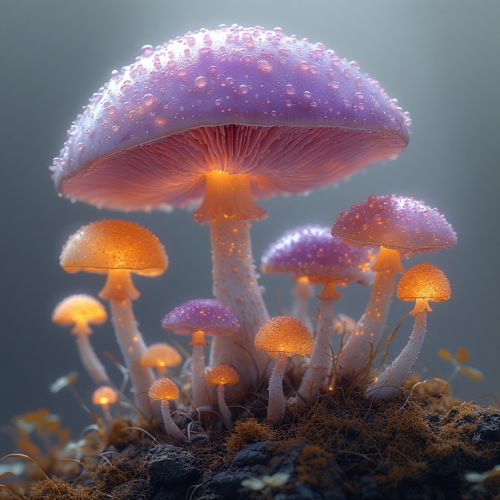 - Stratos Vines (Aureliae lucentis)Classification: Bioluminescent aerial flora; long, ribbon-like trailing vines. Morphology: Stratos Vines feature elongated, semi-translucent ribbons that absorb sunlight during the day and emit a soft silver-blue glow at night. Fine micro-crystalline filaments along the vine surface enhance light diffusion and help anchor the plant to aerial root networks. Habitat: Found on the undersides of floating sky islands, suspended between aerial root networks, terraces, and glider-accessible platforms. Thrives where ambient sunlight and magical energy converge. Behavior & Ecology: Photosynthetic and mildly magical, the vines gather solar energy during daylight hours and release it as gentle illumination at night. They intertwine with crystal-root formations and other airborne vegetation, stabilizing islands and reducing structural drift. Growth patterns respond to sunlight and ambient energy, expanding toward energy-rich zones while avoiding areas of structural congestion. Ecological Role: Anchors floating islands, provides natural illumination for nocturnal aerial fauna, and creates microhabitats for glider-roosting species. Their glow acts as natural navigation markers along aerial travel corridors. Cultural Significance: Integrated into Skybound Festival lanterns, bridge railings, and ceremonial displays. Glider pilots and festival participants rely on the vines’ illumination as guiding lights, and ceremonial pruning is performed to shape patterns and maintain island stability. Notes: Overgrowth can interfere with island buoyancy or create entanglement hazards for gliders. Bloom energy interference may cause erratic light pulses or accelerated growth.  © 2025 HaleyB |
Stats
226 Views
Added on August 27, 2025 Last Updated on August 29, 2025 |
 prev chapter

 Share This
 Email
Email Facebook
 Twitter
 Read Request
 My Library
 Subscribe
 Flag Writing