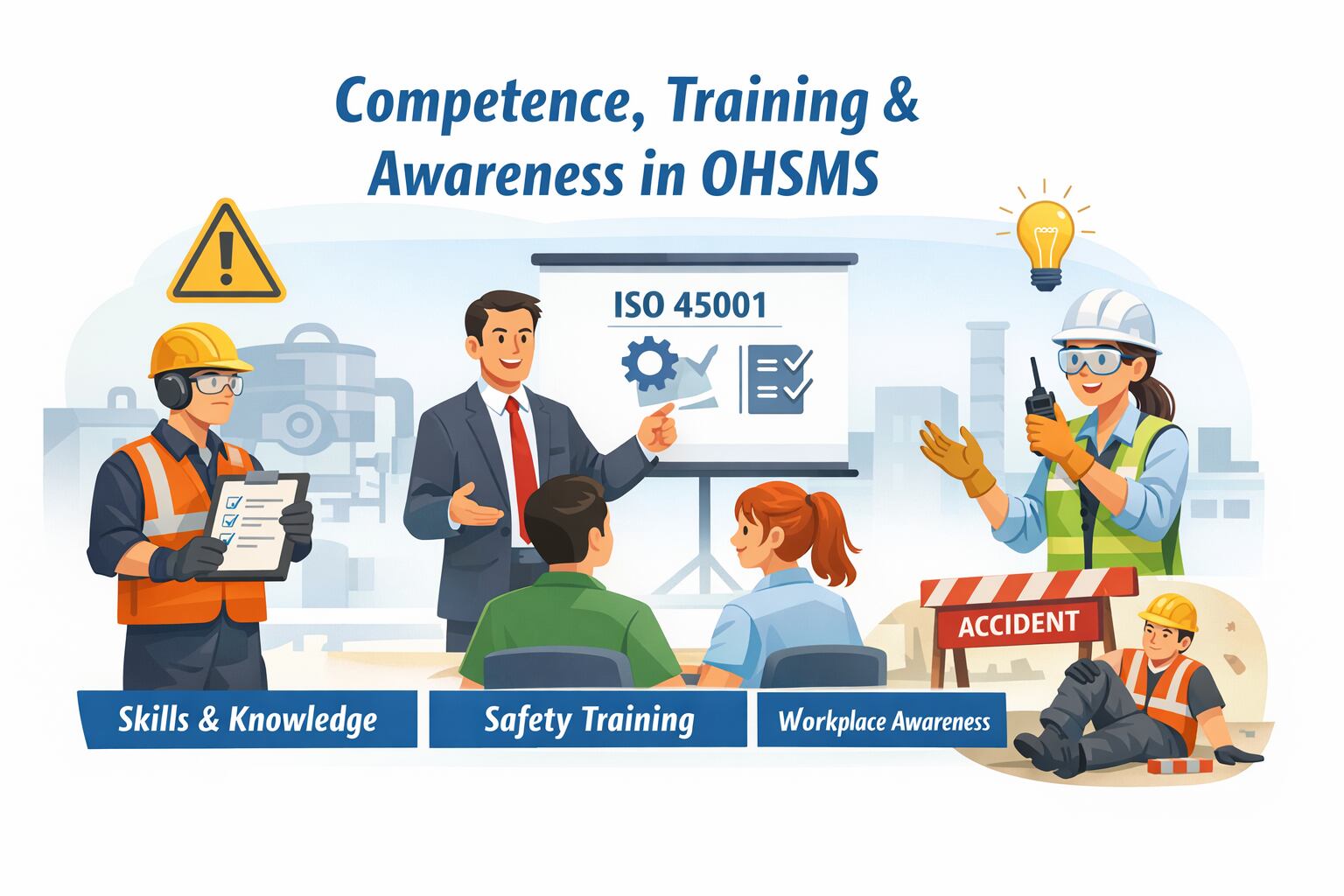
Competence, Training, and Awareness Requirements in OHSMSA Story by Ohsas Safety An Occupational Health and Safety Management System (OHSMS) aims to prevent work-related injuries, ill health, and fatalities by managing risks systematically. An Occupational Health and Safety Management System (OHSMS) aims to prevent work-related injuries, ill health, and fatalities by managing risks systematically. While procedures, controls, and policies are essential components, the effectiveness of an OHSMS largely depends on the people who implement it. Competence, training, and awareness are critical requirements that ensure employees have the necessary knowledge and skills to perform their tasks safely. These elements help organizations build a proactive safety culture and achieve consistent occupational health and safety performance. What is Competence in OHSMS? In the
context of OHSMS, competence refers to a person’s ability to apply appropriate
knowledge, skills, and experience to carry out work activities safely.
Competence goes beyond formal qualifications; it includes practical experience
and an understanding of workplace hazards. An employee may be qualified on
paper but still lack the competence to manage risks effectively. Ensuring
competence is essential because unsafe actions often result from insufficient
skills or lack of understanding of safety responsibilities. OHSMS and ISO 45001 Requirements ISO 45001
places strong emphasis on competence, training, and awareness as part of
organizational responsibility. The standard requires organizations to determine
the competence needed for workers whose activities affect occupational health
and safety performance. It also requires organizations to ensure that workers
are competent based on appropriate education, training, or experience. In
addition, legal and regulatory requirements often mandate specific training for
high-risk activities, making compliance a critical factor in OHSMS
implementation. To meet
these requirements, organizations must create and control ISO 45001 Documents such as training procedures,
competence evaluation records, and awareness materials. Identifying Competence Requirements Identifying
competence requirements begins with understanding job roles and their associated
risks. Organizations should analyse tasks, hazards, and operational controls to
determine the necessary skills and knowledge. Risk-based thinking plays a key
role in this process, as higher-risk activities demand higher levels of
competence. Developing a competence matrix helps map job roles to required
competencies and highlights skill gaps that need to be addressed through
training or supervision. Training as a Tool to Achieve Competence Training
is one of the primary methods used to develop and maintain competence within an
OHSMS. Effective training programs include induction training for new
employees, job-specific training, refresher sessions, and emergency
preparedness training. Training should be planned, delivered by qualified
trainers, and tailored to the needs of different roles. Simply conducting
training is not enough; it must be relevant, practical, and aligned with
workplace risks to truly enhance safety performance. Awareness Requirements in OHSMS Awareness
ensures that employees understand the OHS policy, relevant hazards, risks, and
the consequences of not following safety procedures. Workers should be aware of
their roles and responsibilities within the OHSMS and how their actions
contribute to overall safety performance. Awareness can be promoted through
toolbox talks, safety meetings, posters, internal communications, and
leadership involvement. An aware workforce is more likely to identify unsafe
conditions and take proactive measures. Evaluating Training Effectiveness
and CompetenceEvaluating competence after training is essential to confirm its
effectiveness. Methods such as observations, assessments, audits, and
performance reviews help organizations verify outcomes. Results of evaluations,
corrective actions, and retraining records form part of ISO 45001 documents
and support evidence-based decision-making within the OHSMS. ConclusionCompetence, training, and awareness are essential pillars of an effective
OHSMS. When supported by well-controlled ISO
45001 documents, these elements ensure compliance, reduce
workplace risks, and promote a proactive safety culture. A documented and
competent workforce is key to achieving sustainable occupational health and
safety performance. © 2026 Ohsas Safety |
Stats
15 Views
Added on January 5, 2026 Last Updated on January 5, 2026 Author
Ohsas SafetyLos Angeles, CAAboutThe leading and experienced Occupational Health Safety consultant Global Manager Group, offers ready to use resources on OHSAS. Such, documentation resources that include ISO 45001 safety manual, proc.. more.. |

 Share This
 Email
Email Facebook
 Twitter
 Read Request
 My Library
 Subscribe
 Flag Writing